
Crypto Predictions for 2026 to 2027 (Beginner-Friendly Insights You Can Actually Use)
If you’re new to crypto, predictions can feel like weather reports for a storm that changes direction every hour. People talk with confidence, charts look convincing, and then the market does the opposite.
No one can predict crypto prices with certainty, but we can spot trends and build simple scenarios for 2026 to 2027. A bull market is a long stretch where prices rise and confidence grows. A cycle is a repeating pattern of boom, bust, and recovery that often lines up with Bitcoin’s supply schedule and investor mood. Market cap is the total value of a coin (price times total coins), and it helps you compare “size” across projects.
This guide gives you beginner-friendly predictions, what could drive them, and a practical way to manage risk without guessing every top and bottom.
Key Takeaways
- Crypto prices in 2026 to 2027 will be driven most by liquidity and interest rates, ETF inflows, regulation clarity, and Bitcoin’s post-2024 halving supply effects.
- As of early January 2026, total crypto market cap is about $3.06 trillion, with Bitcoin near $89,810, so doubling again needs major new demand.
- Published Bitcoin forecast ranges (early January 2026) span about $96,000 to $153,000 for 2026, and about $101,000 to $220,000 for 2027, with big volatility likely in all scenarios.
- Ethereum’s 2026 to 2027 outlook depends more on real usage (stablecoins, DeFi, tokenized assets), plus ETF access and regulation, than on simple scarcity.
- A beginner-friendly plan is to use dollar-cost averaging for a core (often BTC and ETH), keep altcoin bets small, and avoid common blowups like leverage, fake yield, and unclear token unlocks.
Big picture for 2026 to 2027: what will move crypto the most?
Crypto prices don’t move on vibes alone. They move when money flows in or out, when rules change, and when headlines shift what people believe is “safe” or “risky.”
As of early January 2026, the total crypto market cap sits around $3.06 trillion, with Bitcoin near $89,810. That context matters because big markets tend to need big fuel to double again.
Here are the forces most likely to shape 2026 and 2027.
Interest rates, liquidity, and the “risk-on” switch
Crypto often acts like a risk asset. When cash is easy to borrow and investors feel optimistic, more money goes into stocks and crypto. When money tightens, investors tend to sell risk and hold cash or short-term bonds.
You don’t need to forecast central banks to use this. Just watch the direction: when markets expect easier conditions, crypto usually breathes better.
Stock market mood (and why the link can weaken)
Bitcoin has often moved with stocks, especially tech. Recent market commentary suggests the correlation could drop in 2026 as crypto becomes more of its own category, helped by regulated products and wider ownership.
That doesn’t mean Bitcoin becomes “uncorrelated” overnight. It means crypto can start responding more to its own demand (ETF flows, onchain activity, regulation news) instead of just mirroring the Nasdaq.
The Bitcoin halving after-effects
Bitcoin’s supply growth gets cut roughly every four years. The 2024 halving reduced the number of new BTC created per day. That matters because when demand stays steady (or rises) while new supply falls, price pressure tends to point up over time.
A quick beginner note: new supply is the fresh Bitcoin that miners earn and can sell. If large buyers absorb most of that, there’s less BTC available on exchanges.
Headlines still matter (maybe more than you think)
Crypto is fast to react and slow to forget. A single court ruling, ETF approval, exchange failure, or security incident can change sentiment for months. In 2026 to 2027, the biggest headline themes are likely to be ETFs, regulation clarity, and real-world usage (payments, tokenized assets, and apps people actually keep using).
ETFs and institutions: why demand could stay strong
ETFs matter because they turn crypto exposure into something many people already understand: a brokerage position.
Early January 2026 flows show how quickly ETFs can pull in capital. On January 2, Bitcoin ETFs recorded about $471 million in net inflows (with BlackRock’s IBIT around $287 million of that), and Ethereum ETFs added about $174 million (with Grayscale’s ETHE leading around $53.69 million). That is a meaningful demand signal in a market where supply is limited.
In plain terms, more buyers than sellers can push price up. If ETFs keep attracting retirement accounts, financial advisers, funds, and even institutions like endowments, demand doesn’t need to be “hype-driven” to be steady.
Regulation clarity: a help and a risk at the same time
The most likely trend for 2026 to 2027 is more defined rules in major markets.
In the US, debates around proposals like the CLARITY Act reflect a push to explain what is a security, what is a commodity, and how crypto trading should be supervised. Clearer rules can open the door to larger pools of capital, because big firms tend to avoid legal gray areas.
The UK is also moving toward a more complete framework, with a timeline pointing to broader rules coming into effect starting in 2027, following earlier steps for areas like stablecoins and market oversight.
There’s a catch: clarity can bring stricter compliance. That can reduce scams and boost trust, but it can also slow certain products, limit listings, and pressure projects that relied on loose standards.
Bitcoin and Ethereum predictions for 2026 to 2027 (simple scenarios)
Price forecasts vary widely, and they’re best used as scenario planning, not promises (this is not a guarantee). The goal is to ask, “What would need to be true for this range to make sense?”
Bitcoin price outlook: new highs are possible, but expect big swings
Forecasts available as of early January 2026 cluster around continued growth into 2026 and 2027, with wide dispersion:
- 2026 forecast range (published estimates): roughly $96,000 to $153,000, depending on source and whether you look at minimum versus maximum projections.
- 2027 forecast range (published estimates): roughly $101,000 to $220,000, again depending on the source and method.
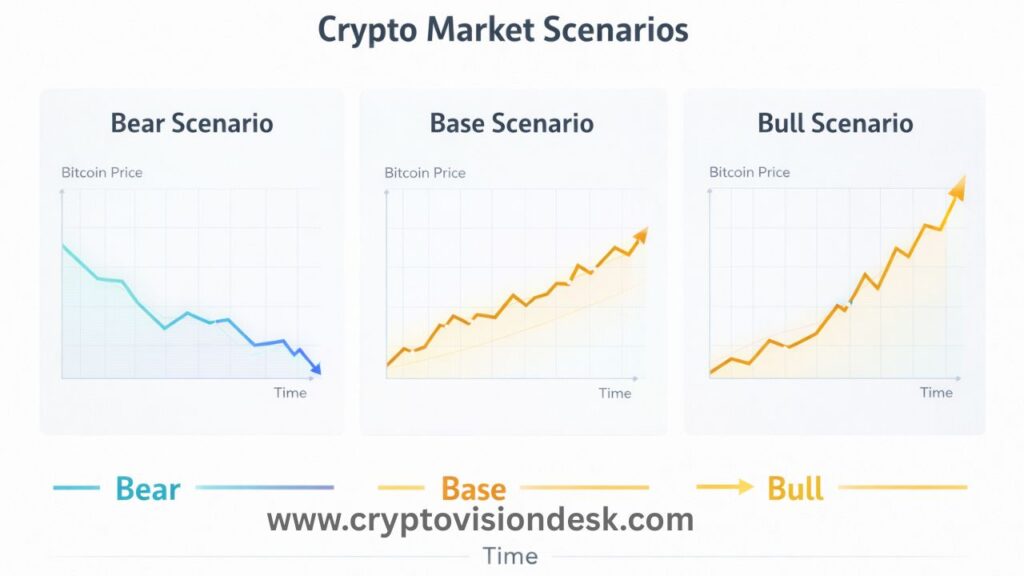
To make this beginner-friendly, here are three scenario bands built from those ranges.
Bear scenario (2026 to 2027): BTC struggles to hold gains and spends time near the lower end of forecasts (roughly the $96,000 to $110,000 zone, with choppy trading).
This can happen if liquidity tightens, a major exchange or lender fails, or regulation turns restrictive in a way that cuts demand.
Base scenario (2026 to 2027): BTC trends upward, but with painful pullbacks, sitting near mid-forecast areas (roughly $120,000 to $195,000 across the period).
This fits a world where ETFs keep gathering assets, broader adoption continues, and macro conditions don’t collapse. Pullbacks still happen because traders take profits and fear returns fast.
Bull scenario (late 2026 into 2027): BTC pushes toward the top end of published estimates (roughly $158,000 to $220,000 in 2027 projections).
For that to happen, ETF demand would likely need to remain strong, with buyers consistently absorbing a large share of available coins. Post-halving scarcity can amplify the move when demand stays persistent.
A simple way to think about Bitcoin: it’s like beachfront property with a strict building limit. If more people want a slice, the price can jump. But if the economy turns or buyers step back, prices can drop fast because many holders are sitting on profits.
Ethereum price outlook: growth depends on apps, ETFs, and real-world use
Ethereum is harder to forecast with clean numbers in public analyst ranges, at least in the same way Bitcoin gets forecasted. Still, several strong themes show up in current market commentary for 2026:
- Ethereum ETFs are already drawing flows alongside Bitcoin ETFs.
- Some analysts expect Ethereum to reach new all-time highs in 2026 if US rules become clearer, because regulated access can increase demand.
- The “why” for Ethereum is less about fixed supply and more about usage: apps, finance, stablecoins, and tokenized assets that settle on Ethereum or its scaling networks.
Beginner scenario planning for ETH looks more like this:
Bear scenario: Activity stays flat, fee revenue weakens, and investor attention shifts to other chains. ETH can still rally with Bitcoin, but it tends to underperform when its app economy cools.
Base scenario: Ethereum grows steadily as a settlement layer for stablecoins, DeFi, and tokenized assets, while scaling tools make fees more predictable. In this world, ETH performs well in risk-on periods, but it still swings hard during market-wide sell-offs.
Bull scenario: Regulation becomes clearer, ETF ownership expands, and real usage rises, not just trading. If tokenized funds, onchain credit, and payments rails keep growing, ETH can benefit from being “in the middle” of a lot of activity.
A simple analogy: Bitcoin is often treated like a scarce asset, Ethereum is more like a busy highway. Price depends on how much traffic runs through it, and whether people keep choosing that route.
Altcoins in 2026 to 2027: where beginners should be careful and what to watch
Altcoins can rise faster than Bitcoin. They can also fall harder, because they usually rely on momentum, narratives, and thinner liquidity.
If you’re new, the safest improvement you can make is to stop thinking in single-coin predictions and start thinking in categories and signals.
Here’s a checklist that doesn’t require advanced skills:
- Real demand: Are users doing something beyond trading?
- Developer activity: Is the project shipping updates and tools?
- Token supply facts: How many coins exist, and what gets unlocked next?
- Liquidity: Can you buy and sell without huge price slippage?
- Clear story: If you can’t explain why it should exist in two sentences, be cautious.
Likely winners if the market is strong: smart contract chains and big networks
A smart contract chain is a blockchain that runs programs (apps) that can hold and move value without a central operator.
If 2026 to 2027 stays constructive, large networks that host apps tend to do well because they attract builders, users, and liquidity.
Solana is one chain often mentioned in institutional adoption narratives. Current market commentary highlights the idea that ETFs and large buyers could absorb a meaningful share of new supply for major assets, including Solana, if more regulated products expand. What matters for beginners is the principle: when big pools of money can buy easily, demand can become more consistent.
Still, smart contract chains compete hard. User experience, outages, app quality, and security incidents can shift sentiment quickly.
High-attention coins: XRP, ADA, and DOGE can move fast on news
Some coins move less on fundamentals and more on attention. In early January 2026 price action, coins like XRP, Cardano (ADA), and Dogecoin (DOGE) showed sharp daily moves.
These types of assets often react to:
- Listings and brokerage access
- Legal and policy updates
- Social media waves and influencer hype
- Sudden rotations when traders chase faster gains than Bitcoin
If you want exposure, treat it like volatile inventory, not a retirement plan. Look for real usage, active developers, and clear token supply info before you buy. If the supply schedule is confusing or the project can’t explain value without buzz, that’s a sign to step back.
Fast-growing themes: stablecoins, tokenized real-world assets, and crypto futures
Some of the biggest 2026 to 2027 growth may come from “plumbing,” not celebrity coins.
Stablecoins are digital dollars. They matter because people can move value 24/7, settle trades fast, and send payments without bank hours. If stablecoin rules get clearer, more payment firms and banks may participate.
Tokenized real-world assets (RWAs) are things like stocks, bonds, or real estate represented on a blockchain. The pitch is simple: faster settlement, fractional ownership, and easier transfer. If even a small part of traditional finance moves onchain, it can lift the whole ecosystem.
Futures and perpetuals are trading products that let you bet on price without holding the coin. They’re popular because they’re liquid and efficient, but they can wreck beginners fast. Leverage magnifies gains, and it also magnifies mistakes.
Beginner safety plan for 2026 to 2027: how to use predictions without getting burned
Predictions are only useful if they change your behavior in a calm way.
Try this simple framework:
- If the market is rising fast: stick to your plan, take some profit on risky coins, and don’t increase leverage.
- If the market drops hard: slow down, keep position sizes small, and avoid panic selling assets you chose for the long term.
- If the market chops sideways: keep learning, keep security tight, and don’t chase random pumps out of boredom.
The goal is to survive long enough to benefit from the upside.
A simple strategy many beginners use: dollar-cost averaging and “core plus small bets”
Dollar-cost averaging (DCA) means buying a fixed amount on a schedule, like weekly or monthly, no matter what the price does.
Example: you buy $50 of BTC every Friday for a year. When price dips, you automatically buy more sats. When price runs, you still add, but your average cost smooths out.
A common setup is core plus small bets:
- Core: BTC and ETH (for many people), because they’re the most established and easiest to access through regulated routes.
- Small bets: a limited slice in altcoins you’ve researched, sized small enough that a 60 percent drop doesn’t ruin your sleep.
Also keep the basics boring and safe: use reputable exchanges, turn on 2FA, and understand the difference between leaving coins on an exchange versus holding them in your own wallet.
Red flags to avoid in the next cycle: scams, leverage, and fake yields
Most big losses in crypto come from the same traps, just with new branding.
Watch out for:
- Guaranteed returns or “can’t lose” claims
- “Risk-free yield” offers that don’t explain where money comes from
- Unknown teams that won’t show track records
- Confusing token unlock schedules that dump supply later
- High leverage, especially during hype phases
A quick due-diligence checklist helps:
- Liquidity: is it easy to exit without crashing the price?
- Token supply: what’s circulating now, what unlocks later?
- Audits: has credible security work been done?
- Business model: how does the project actually make money or sustain itself?
Frequently Asked Questions About Crypto Predictions for 2026 to 2027
Can anyone predict crypto prices for 2026 to 2027?
No one can predict crypto prices with certainty. The practical use of predictions is scenario planning, then managing risk with clear rules, rather than trying to guess exact tops and bottoms.
What factors will move crypto the most in 2026 and 2027?
The biggest drivers are interest rates and liquidity (risk-on versus risk-off), ETF flows, regulation clarity, and major headlines like court rulings or exchange failures. Bitcoin’s post-halving supply reduction also matters because new supply can be absorbed faster when demand stays strong.
What Bitcoin price ranges are being forecast for 2026 and 2027?
Published estimates available as of early January 2026 range from about $96,000 to $153,000 for 2026, and about $101,000 to $220,000 for 2027. These ranges are best treated as scenario bands, not promises.
Why do Bitcoin ETFs and Ethereum ETFs matter for price?
ETFs make crypto exposure easy to buy in a brokerage account, which can bring steady demand from advisers, retirement accounts, and institutions. Your article also gives a clear example of how flows can show up fast, with about $471 million in net inflows for Bitcoin ETFs and about $174 million for Ethereum ETFs on January 2, 2026.
What’s the safest way for beginners to use crypto predictions?
Use a simple plan you can follow in calm and scary markets. Many beginners use dollar-cost averaging, keep a core position (often BTC and ETH), size altcoin bets small, and avoid common traps like high leverage, “guaranteed” returns, and unclear token unlock schedules.
Conclusion
Crypto predictions for 2026 to 2027 point to a market driven by ETF demand, post-halving supply dynamics, and clearer regulation, with volatility as the price of admission. Bitcoin forecasts published in early January 2026 span roughly $96,000 to $153,000 for 2026 and roughly $101,000 to $220,000 for 2027, while Ethereum’s outlook depends more on app growth, ETF access, and real-world usage than on simple scarcity.
Your next step is simple: pick a plan, write down rules, and track a few signals that matter, ETF flows, regulation news, and real usage (users, volume, and onchain activity). The people who do best in the next cycle usually aren’t the best guessers, they’re the best planners.
Read Also: Hardware Wallets in 2026: Secure Your Crypto Today
Disclaimer
The information provided on this website is published in good faith and for general informational and educational purposes only. It does not constitute financial, investment, trading, legal, or tax advice of any kind.
Cryptocurrencies and digital assets are highly volatile and involve substantial risk. Market conditions can change rapidly, and users may lose some or all of their invested capital. Any actions taken based on the information found on this website are strictly at the reader’s own risk.
References to cryptocurrencies, exchanges, wallets, tools, platforms, or strategies are shared solely for educational awareness and should not be interpreted as recommendations, endorsements, or professional advice.
Readers are advised to conduct their own research (DYOR) and seek guidance from a qualified financial advisor, tax consultant, or legal professional before making any financial or investment decisions.
Cryptocurrency laws, regulations, and taxation policies—particularly in India—may change over time. The content on this website is based on publicly available information at the time of publication and may not reflect the most recent legal or regulatory updates.
The website owner, authors, and contributors do not accept any liability for losses, damages, or consequences arising from the use of the information provided on this website.
Some content on this website may contain affiliate links. This means we may earn a small commission at no additional cost to you. This does not influence the accuracy, transparency, or integrity of the content.