
Buying Crypto in India Without Surprises (Fees, Spreads, Bank Declines)
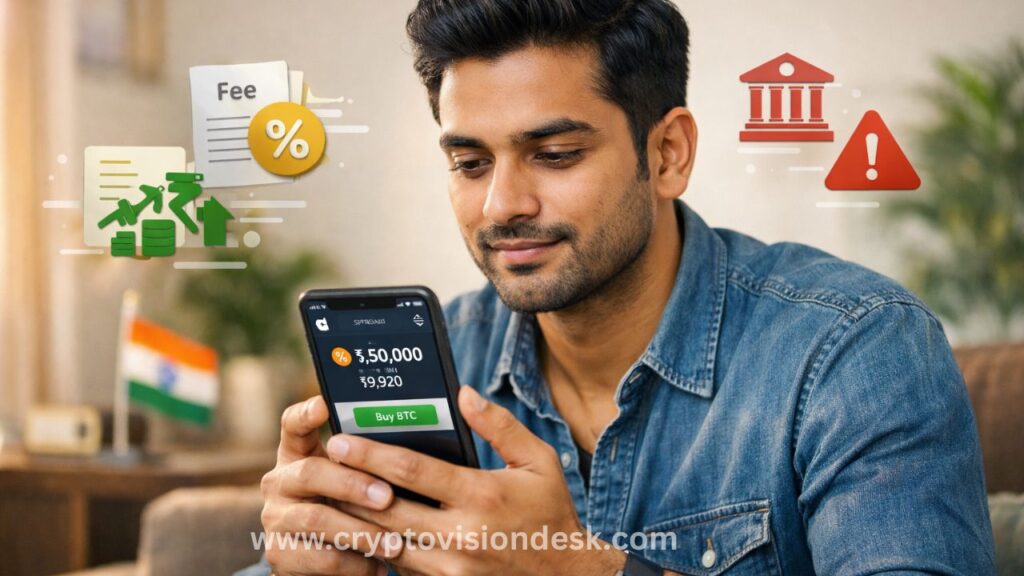
You try to buy crypto in India with a simple plan: add money, tap “Buy”, done. Then reality hits. The price looks higher than Google, UPI fails, your bank declines the transfer, and after the trade your balance feels smaller than it should.
The good news is that most of these surprises are predictable. You can plan around fees, spreads, and payment issues if you know what to check before you click buy.
This guide gives you a calm, beginner-friendly plan to buy crypto in January 2026 with fewer shocks: how to estimate your total cost, how to choose between an Indian exchange and P2P, how to reduce bank declines, and how to do a small test run first. Rules and platform support can change, so always double check deposit methods and fee pages inside the app before you send money.
Key Takeaways
- Your real crypto cost in India includes trading fees, spread, deposit and withdrawal fees, and 1% TDS on certain sells or swaps, not just the listed coin price.
- “Instant buy” screens often hide the spread inside the quote, compare the buy quote and sell quote back-to-back to spot the gap.
- For fewer moving parts, start with a compliant Indian exchange that supports INR deposit and INR withdrawal for your account, then do a small test loop (deposit, buy, sell a little, withdraw).
- P2P can sometimes be cheaper, but it adds scam risk and more bank scrutiny, follow strict rules (escrow only, high-rated sellers, no off-platform chat, no third-party payments).
- Reduce bank declines by keeping clean KYC (matching names), using your own bank account, starting with small deposits, spacing transfers, and keeping IMPS or NEFT as a backup.
Know the real cost before you buy, fees, spreads, and taxes add up
When an app shows “BTC price ₹X”, that’s not always what you pay. Your real cost is the full stack of friction around the trade.
Think in total cost, not just “trading fee”.
Here’s what can affect how much crypto you end up with:
| Cost item | What it means | Where beginners miss it |
|---|---|---|
| Trading fee | The platform’s fee to execute the trade | It’s small, so people ignore it, then repeat trades often |
| Spread | The gap between buy price and sell price | “Instant buy” screens hide it inside the quote |
| Deposit fee | Fee to add INR (often zero, but not always) | Payment partners can add charges or limits |
| Withdrawal fee (INR) | Fee to send INR back to your bank | Some platforms charge per withdrawal or have minimums |
| Withdrawal fee (crypto) | Network fee to move crypto to your wallet | Changes by network and congestion |
| 1% TDS | Tax deducted on certain crypto sales or swaps | Frequent trades slowly shrink your usable balance |
A simple example makes this clear.
A quick cost example (₹10,000 first buy)
Let’s say you deposit ₹10,000 to buy BTC or ETH.
- You use an “instant buy” quote.
- The app’s trading fee is 0.20% (varies by platform and product).
- The spread built into the quote is 0.60% (this also varies).
- Later, you sell and move INR back to your bank, and 1% TDS applies on the sale.
On the buy:
- Spread cost: about ₹60 (0.60% of ₹10,000)
- Trading fee: about ₹20 (0.20% of ₹10,000)
So your effective buying power becomes roughly ₹9,920, even before you think about withdrawals.
On the sell later (example only):
- If you sell crypto worth ₹10,500, the exchange may deduct about ₹105 as 1% TDS (subject to rules and thresholds).
- You can usually claim that TDS in your tax filing, but it still reduces your usable cash today.
The point is not the exact rupees. The point is the habit: estimate the full cost before you place the order, and you’ll stop feeling “cheated” by normal mechanics.
Read Also: How to Buy Bitcoin Safely in India (2026 Step-by-Step Guide)
Fees vs spread, the simple way to spot hidden costs
Trading fee is what the platform charges to process the order. It’s usually shown on the fee page, and sometimes shown on the order preview.
Spread is the difference between the price you can buy at and the price you can sell at right now. You feel it most on instant buy or quick convert screens.
A fast way to spot hidden cost:
- Compare the buy quote to the sell quote immediately. If you buy 1 unit now and sell it right back, the gap you see is mostly spread (plus fees).
- Sanity check with a global reference price. If BTC is showing far above the broad market rate, you’re paying extra somewhere (spread, mark-up, or low liquidity).
- Use major pairs first, like BTC/INR, ETH/INR, and USDT/INR. These are usually more liquid than small tokens, which often means tighter spreads.
- Prefer limit orders when available. A limit order lets you set your price. Market orders can fill at worse prices during fast moves, and that “silent slip” becomes your hidden cost.
If an app pushes you toward “one-tap buy”, treat it like buying water at an airport. It’s convenient, but you pay for convenience.
TDS and taxes in India, why your balance may look smaller
Crypto in India is taxed under the Virtual Digital Asset (VDA) rules. Beginners don’t need every clause to buy safely, but you do need the basics because they affect your cash flow.
- 1% TDS: On certain crypto sales or trades (subject to thresholds and how the trade is structured), 1% of the transaction value can be deducted as TDS. Many Indian exchanges automate this and show it in reports.
- 30% tax on profits: Profits from selling or trading VDAs are taxed at 30 percent, plus applicable surcharge and cess.
Here’s the practical issue: frequent trading can lock up money.
Even if you’re barely up or even flat, repeated sells and swaps can trigger repeated 1% TDS deductions. Over dozens of trades, it adds up and your available balance shrinks, even before you pay final tax.
What to do from day one:
- Keep records of buys, sells, fees, and TDS.
- Download trade reports from the exchange.
- Consider using a crypto tax tracker if you do more than a few trades.
This is general education, not tax advice. If you’re unsure, ask a qualified tax professional who understands VDA rules.
Choose a buying route that fits your risk level, Indian exchanges vs P2P
In India, most beginners end up choosing one of two routes:
- Direct INR on an Indian exchange (UPI, IMPS, NEFT where supported).
- P2P buying (often USDT) and then trading.
Both can work. The “right” choice depends on what you value more: simplicity and support, or price and flexibility.
A strong beginner rule: start with the simplest route that works with your bank, and do small tests before you scale. Also, avoid leaving long-term savings sitting on any exchange.
The simplest path, buy with INR on an Indian exchange using UPI or IMPS
If you want fewer moving parts, start with a compliant Indian exchange that supports INR deposits and withdrawals. Many Indian users commonly discuss platforms such as CoinDCX, Mudrex, and ZebPay for beginner-friendly flows, and CoinSwitch is also often mentioned for a simple app experience. There’s no single “best” exchange for everyone, because fees, spreads, and banking support can differ by user and time.
What to look for before signing up:
- Compliance focus (many platforms serving India operate as FIU-IND registered reporting entities).
- A clear fee page that separates trading fees from other charges.
- Working INR deposit and INR withdrawal for your account, not just “supported in theory”.
- Strong KYC with your own details (this reduces payment issues later).
- Support that can answer basic deposit and withdrawal questions.
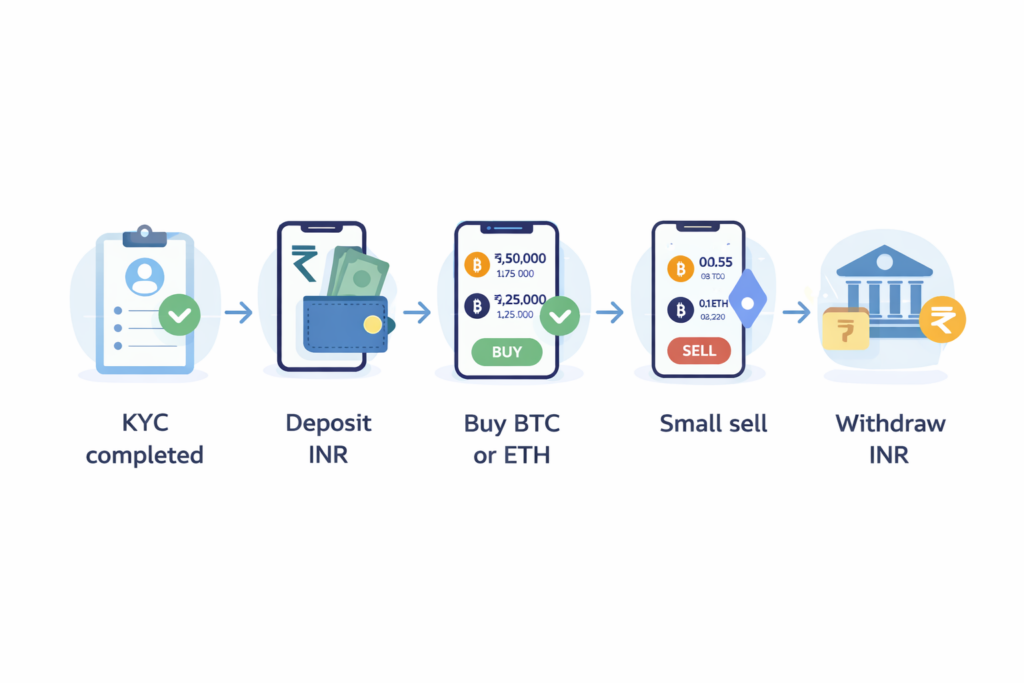
A safe first-week plan that avoids surprises:
- Finish KYC and set up 2FA.
- Deposit a small test amount.
- Buy a major coin (BTC, ETH, or even USDT if you’re learning).
- Sell a small part.
- Withdraw INR back to your bank.
That last step matters. Many people only discover friction when they try to move money out.
The P2P path, lower spreads sometimes, but you must follow strict safety rules
P2P means you buy from another user. You send INR by UPI or bank transfer, and the platform releases crypto (often USDT) from escrow when the seller confirms payment.
Many Indians use Binance P2P for this flow, and some India-focused platforms also offer P2P options. P2P can sometimes give better pricing than instant buy quotes, but it adds two risks: scams and bank scrutiny.
P2P in simple steps:
- Choose USDT (or another asset) on the P2P page.
- Pick a seller, place an order.
- Pay the seller using the listed method.
- Mark as paid.
- Seller releases crypto from escrow.
Strict safety rules that protect beginners:
- Choose sellers with a high rating and a large number of completed trades.
- Keep all conversation inside the platform chat.
- Never accept “Let’s do it outside the platform” offers, even if the rate looks better.
- Don’t agree to name changes, third-party accounts, or “send from your friend’s UPI”.
- Save proof of payment (screenshots, transfer reference numbers).
One careless step can turn a simple buy into a dispute, or worse, a bank complaint situation. If you want fewer headaches, keep P2P as a second step after you’re comfortable with direct INR buying.
Read Also: 5 Crypto Mistakes Beginners Make in 2026, Avoid These
Avoid bank declines and UPI problems, what causes them and how to plan around them
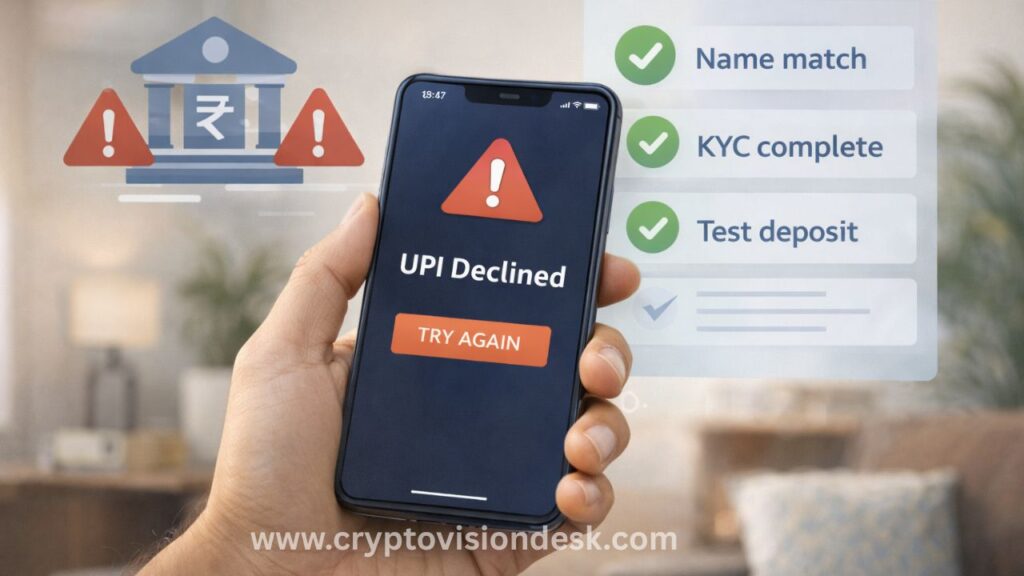
Payment failures feel personal, but most are routine risk controls. There’s no single rule that every bank follows, and behavior can change over time.
The smart move is to reduce the triggers that make your transaction look risky, and to keep a backup deposit method ready.
Why UPI or bank transfers fail for crypto, common triggers to know
Common reasons deposits fail or get reversed:
- Bank risk checks flag the transfer based on recipient patterns or transaction type.
- A large first-time transfer to a new recipient.
- Many small transfers in a short period (looks unusual).
- Name mismatch between your bank account and your exchange KYC.
- Using someone else’s bank account, even a family member’s.
- Payment remarks that raise flags (some users type “crypto”, which can trigger review).
- Temporary changes in payment partner rails inside the exchange app.
None of this means you did something wrong. It means banks and payment systems treat crypto-related flows as high-risk.
A simple plan to reduce declines, small tests, clean KYC, and backup rails
A low-drama plan that works for most beginners:
- Make sure your PAN, Aadhaar name, and bank account name match as closely as possible.
- Complete exchange KYC before sending meaningful amounts.
- Start with a test deposit of ₹500 to ₹2,000.
- If UPI fails, try IMPS or NEFT (often more reliable).
- Use your own bank account only. Avoid third-party transfers.
- Don’t do five deposits in one day. Keep transfers few and spaced.
- Increase your deposit size slowly over a few weeks, not in one jump.
If a deposit gets declined:
- Stop repeated attempts. Multiple failures can trigger stricter blocks.
- Contact exchange support with the transaction reference.
- If needed, contact your bank and ask what transfer method they prefer for that recipient (keep it simple and factual).
Avoid panic moves like sending money to random accounts, chasing “special links”, or switching to sketchy shortcuts. That’s how beginners get trapped.
A beginner checklist to buy crypto in India with fewer surprises
Crypto has seen exchange freezes, hacks, and sudden policy changes over the years. That’s why the goal is not just “buy”, it’s buy and stay in control.
Before you click buy, quick checklist to avoid surprises
- Confirm the deposit method is live for your account inside the app (UPI, IMPS, NEFT).
- Read the trading fee page and the withdrawal fee page (INR and crypto).
- Check spread by comparing the buy quote vs sell quote for the same coin.
- Stick to major coins for your first buy (BTC, ETH, or USDT).
- Turn on 2FA using an authenticator app, not just SMS.
- Decide your goal: long-term holding, or learning with small amounts.
- Only use money you can afford to have temporarily locked due to TDS, bank review, or withdrawal delays.
Your first purchase script, deposit, buy, sell a little, withdraw, then scale
Use this like a rehearsal before you put real money in:
- Deposit ₹500 to ₹2,000.
- Place a limit order if the exchange supports it, otherwise use the smallest instant buy available.
- Write down what happened: deposit time, fees shown, and the final crypto received.
- Sell 10 to 20 percent of what you bought.
- Withdraw that INR back to your bank.
- Once you trust the full loop, increase your deposit size slowly.
- When your holdings become meaningful to you, move long-term coins to a personal wallet. If you withdraw crypto, remember there’s a network fee, so fewer larger withdrawals can cost less than many tiny ones.
This one loop solves most beginner anxiety. You stop guessing and start measuring.
Frequently Asked Questions About Buying Crypto in India (Fees, Spreads, UPI, and Bank Declines)
Why is the crypto price on an app higher than the price on Google?
App “buy” prices can include spread, markups, and low liquidity on certain pairs. Instant buy or quick convert screens often bake the spread into the quote, so the displayed price looks higher than a global reference. A quick check is to compare the app’s buy quote and sell quote right away, the gap is mostly spread plus fees.
What is the spread in crypto, and how do I check it fast?
Spread is the difference between the price you can buy at and the price you can sell at right now. To check it, open the same coin and compare the buy quote versus the sell quote within seconds. If the gap looks large, try major pairs like BTC/INR, ETH/INR, or USDT/INR, and use limit orders when the exchange supports them.
What is 1% TDS on crypto in India, and why does it reduce my balance?
Under India’s VDA rules, 1% TDS may be deducted on certain crypto sales or swaps (depending on structure and thresholds). Even if you can claim it later in your tax filing, it reduces your usable cash today. If you trade often, repeated TDS deductions can lock up money and make your balance feel like it is shrinking.
Why do UPI deposits fail or banks decline crypto-related transfers?
Failures usually come from risk checks, not from anything personal. Common triggers include large first-time transfers, many small transfers in a short time, name mismatches between your bank and exchange KYC, using someone else’s account, and payment rail changes inside the exchange app. Banks and payment systems often treat crypto-related flows as higher risk, so rules can change over time.
Should beginners in India use an exchange or P2P to buy crypto?
Most beginners should start with a direct INR route on an Indian exchange because it has fewer steps and clearer support, then run a small test loop first. P2P can sometimes offer better pricing, but it adds scam risk and more strict safety needs (escrow only, high-rated sellers, proof of payment, no off-platform deals, no third-party transfers). A simple rule is to start with the simplest method that works with your bank, then expand.
Read Also: NFTs in 2026: Dead or Back? Honest Market Breakdown
Conclusion
Buying crypto in India without surprises comes down to a few habits: plan for total cost (fees, spread, withdrawals, and 1% TDS), choose a route that matches your comfort level, and expect some payment friction at the start. Start with BTC or ETH, keep clean records, and don’t trade so often that TDS eats your working balance.
Save the checklist, then do one small test buy this week. Once the deposit, trade, and withdrawal all work on your setup, scaling up feels a lot less stressful, and a lot more controlled.
Disclaimer
The information provided on this website is published in good faith and for general informational and educational purposes only. It does not constitute financial, investment, trading, legal, or tax advice of any kind.
Cryptocurrencies and digital assets are highly volatile and involve substantial risk. Market conditions can change rapidly, and users may lose some or all of their invested capital. Any actions taken based on the information found on this website are strictly at the reader’s own risk.
References to cryptocurrencies, exchanges, wallets, tools, platforms, or strategies are shared solely for educational awareness and should not be interpreted as recommendations, endorsements, or professional advice.
Readers are advised to conduct their own research (DYOR) and seek guidance from a qualified financial advisor, tax consultant, or legal professional before making any financial or investment decisions.
Cryptocurrency laws, regulations, and taxation policies—particularly in India—may change over time. The content on this website is based on publicly available information at the time of publication and may not reflect the most recent legal or regulatory updates.
The website owner, authors, and contributors do not accept any liability for losses, damages, or consequences arising from the use of the information provided on this website.
Some content on this website may contain affiliate links. This means we may earn a small commission at no additional cost to you. This does not influence the accuracy, transparency, or integrity of the content.