
DeFi for Beginners: How Lending, Borrowing, and Staking Work (Without the Hype)
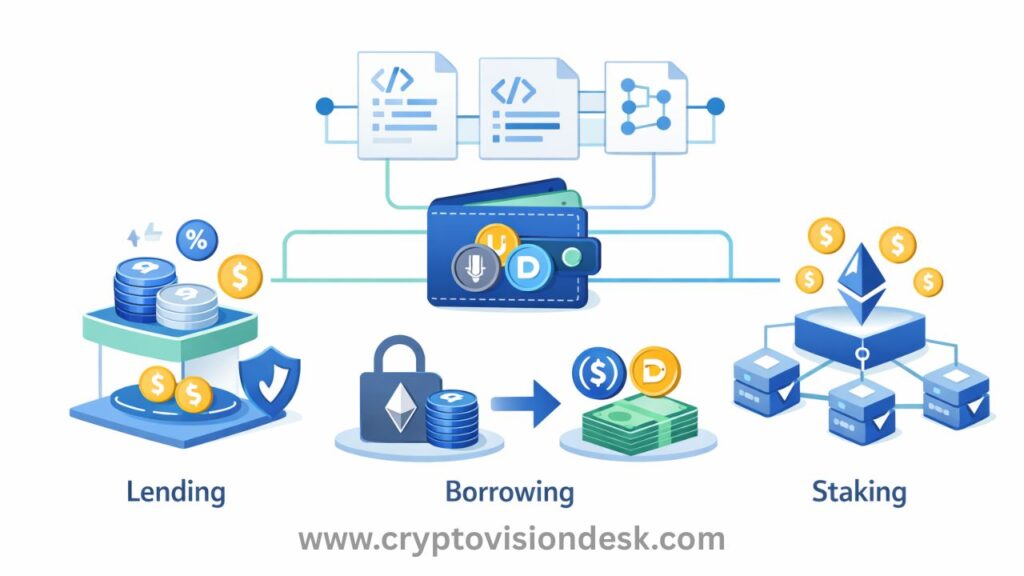
You’ve probably heard that DeFi can pay interest, offer loans without a bank, and reward you for staking. That sounds like a money cheat code, until you try it and realize there’s no help desk, no password reset, and no “undo” button.
Here’s the simple idea: DeFi is money tools run by code (smart contracts), not by bank staff. You connect a wallet, sign a few approvals, and the rules run on their own.
This guide breaks down the three actions most beginners start with: lending, borrowing, and staking. The examples stick to familiar assets like stablecoins (USDC, DAI) and ETH so it’s easier to follow. You can start small, but only if you respect the risks first.
DeFi basics: wallets, smart contracts, and why people use them
What DeFi is (in plain English)
DeFi (short for decentralized finance) is a set of apps that let you do finance tasks, like earning interest or taking a loan, using a crypto wallet instead of a bank account.
Behind the scenes, DeFi apps use smart contracts, which are programs that hold funds and follow rules like “pay lenders interest” or “sell collateral if a loan gets too risky.” You don’t need to know how to code, but you do need to know that the code is in charge.
Liquidity pools: the shared bucket idea
A lot of DeFi runs on liquidity pools. Picture a shared bucket of USDC. Lenders add USDC to the bucket. Borrowers take USDC out, but they pay interest back in. That interest flows to the lenders.
Some newer designs match lenders and borrowers more directly, but the beginner experience still feels similar: you supply funds, you earn yield; or you add collateral, you borrow.
Self-custody changes the rules
In most DeFi setups, you use a self-custody wallet. That means:
- You control the keys, so you control the money.
- No one can freeze your account because they don’t run it.
- If you send funds to the wrong address, it’s usually gone.
- If you sign a bad transaction, there’s no chargeback.
It’s freedom with sharp edges. Treat your wallet like a cash wallet mixed with an online banking app.
Terms you’ll see on lending, borrowing, and staking screens
- APY: Annual percentage yield. A rough yearly rate, often changing daily.
- Collateral: The asset you lock up to borrow something else.
- Gas fees: Network fees you pay to send transactions (approve, supply, withdraw).
- Liquidation: When the protocol sells your collateral to repay your debt.
- Stablecoins: Tokens designed to track $1, like USDC or DAI. They’re useful, but not risk-free.
- Health factor (common on lending apps): A safety score for your loan. Higher is safer.
DeFi can be simple on the surface, but the risk comes from the details hidden behind these words.
What you need before you start: a wallet, a little crypto, and a plan
You don’t need a big portfolio to start. You do need a clean setup.
Beginner setup steps
- Pick a well-known wallet (browser extension or mobile).
- Write down your seed phrase on paper and store it offline.
- Add a small amount of crypto for fees (often ETH, depending on the chain).
- Start with a test amount, like $50 to $100, so mistakes don’t hurt much.
Quick checklist before you connect a wallet
- Use official links from trusted sources (project docs, verified social accounts).
- Double-check the domain spelling. Fake sites often look perfect.
- Avoid links from DMs, sponsored replies, or “support” accounts.
- Look for signs the app is established (clear docs, long history, audits, large usage), but remember audits aren’t a guarantee.
Pick a chain with intent Fees and speed depend on the network you use. Ethereum is still the main hub for liquidity and reputation, but many protocols also run on lower-fee networks. As a beginner, pick one chain and stick with it for a while, switching chains too early adds confusion and extra risk.
How DeFi interest rates work: why APY changes and what fees do to returns
DeFi rates move because of supply and demand inside the pool.
- If lots of people deposit USDC and few borrow it, lenders usually earn less.
- If many people want to borrow USDC, lenders often earn more because borrowers pay more.
You’ll also see two borrowing rate styles on some apps:
- Variable rate: Moves with demand. It can drop, but it can spike fast.
- Stable rate: More predictable, but not always truly fixed. Protocol rules can adjust it.
Fees matter more than beginners expect. Two common return killers are:
- Network fees (gas): If you pay $10 to deposit and $10 to withdraw, a small account may lose money even with a decent APY.
- Protocol features and incentives: Some yields include bonus tokens, which can rise or fall in price.
A good habit: before you click supply, estimate how long it will take your interest to cover the fees you’ll pay getting in and out.
How DeFi lending and borrowing work (with a simple example)
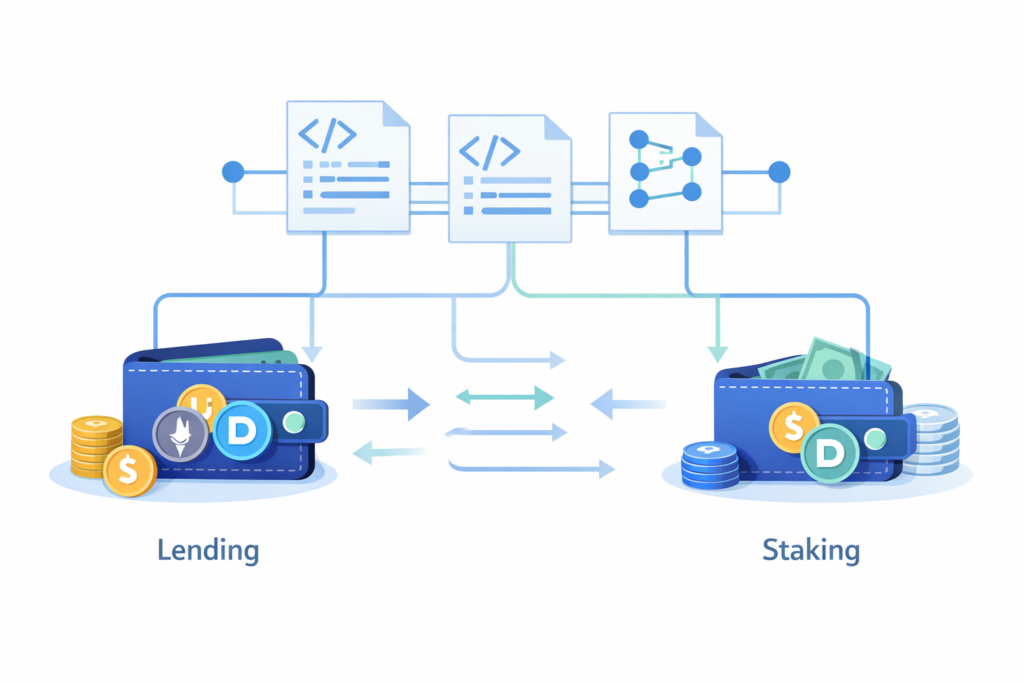
DeFi lending and borrowing is basically the pawn shop model, but automated.
- Lenders deposit assets into a pool and earn interest.
- Borrowers lock collateral (often more value than they borrow) and take a loan.
There’s usually no credit check. The collateral is the safety net.
Three well-known names beginners run into:
- Aave: Large lending markets across multiple networks, offers variable and stable borrowing rates.
- Compound: A classic lending protocol where deposits earn interest through tokenized positions.
- MakerDAO (DAI): Known for borrowing by locking collateral to generate DAI.
You don’t need to use all of them. The key is understanding the flow.
Lending crypto: deposit into a pool, earn interest, withdraw when you want
The basic lending steps look like this on most apps:
- Connect your wallet.
- Choose the asset (example: USDC).
- Review the current APY and any notes (like caps or limited liquidity).
- Approve the token (this gives the smart contract permission to move your USDC).
- Supply the amount you want.
- Watch your balance grow, then withdraw when you’re ready.
When you supply, you may receive a “receipt” token or your wallet may show a supplied balance in the app. Either way, it represents your claim on the pool plus interest.
Where the yield comes from Most of the base yield comes from borrowers paying interest. Some protocols also hand out extra rewards, but those can change and sometimes disappear.
A simple example with round numbers Say you supply 500 USDC to a lending pool showing 4% APY (rates vary all the time). If the rate stayed the same for a year, you’d earn about 20 USDC. In real life, the APY will drift, and your real result depends on how long you stay supplied and what fees you pay to enter and exit.
Lending feels calm compared to trading, but it’s not risk-free. Smart contracts can fail, stablecoins can wobble, and liquidity can tighten during panic moments.
Borrowing in DeFi: collateral, health factor, and liquidation in plain English
Borrowing is where beginners get into trouble, mostly because they borrow too close to the maximum.
Here’s the normal flow:
- Deposit collateral (example: ETH).
- The app calculates how much you can borrow, based on a collateral ratio.
- You borrow a token (example: USDC).
- Your loan stays open until you repay, or until liquidation.
Overcollateralized loans are the default Many DeFi loans require collateral well above the loan value, often 120% to 150% or more depending on the asset and protocol rules. That buffer exists because crypto prices move fast.
Health factor is your warning light A health factor is a safety score. If it drops too low, liquidation becomes likely. The exact math differs by protocol, but the idea is consistent: the closer you borrow to the limit, the faster a price drop can wipe you out.
A simple liquidation scenario
- You deposit ETH as collateral.
- You borrow USDC against it.
- ETH price drops sharply.
- Your collateral value falls, your health factor drops, and the protocol can automatically sell some of your ETH to repay the USDC debt.
Liquidation often includes a penalty. That means you can lose more than you expected, even if you planned to “just wait for price to recover.”
Beginner guardrails that actually work
- Borrow far below the max (many people aim for a wide buffer).
- Keep extra funds ready so you can repay fast if markets move.
- Set price alerts for your collateral.
- Avoid borrowing against volatile assets if you can’t watch the position.
Borrowing can be useful, but it’s not free money. It’s a loan that can margin-call you at the worst time.
Staking explained: earn rewards for helping a blockchain run
Staking is not lending. When you stake, you help secure a proof-of-stake network by supporting validators. In return, the network pays rewards.
Ethereum is the most common beginner starting point for staking, mostly because it’s widely used and deeply integrated into wallets and apps.
There are two main staking paths:
- Native staking: Stake the asset directly under the network’s rules.
- Liquid staking: Stake through a provider, receive a liquid token you can move or use elsewhere.
You’ll see names like Lido and Rocket Pool when people talk about liquid staking on Ethereum. They’re well-known, but they still come with tradeoffs.
Native staking vs liquid staking: what you get back and what can go wrong
Native staking (simple idea) You lock tokens for staking, earn staking rewards, and follow the unstake rules. Some networks have an unbonding period, so you may not be able to exit right away.
Pros: fewer moving parts. Cons: less flexibility, sometimes higher minimums or more setup.
Liquid staking (simple idea) You stake ETH and receive a token that represents your staked position (for example, a token that tracks staked ETH value). You can hold it, trade it, or use it in other DeFi apps while still earning staking rewards.
Pros: more flexibility, easier to use across DeFi. Cons: more risks.
Key staking risks beginners should know
- Smart contract risk: Liquid staking uses contracts that can fail.
- Depeg risk: A liquid staking token can trade below the value you expect, especially during stress.
- Validator risk and slashing: Validators can be penalized for bad behavior or mistakes, which can reduce returns.
Staking is often calmer than borrowing, but it’s still not a savings account.
Staking rewards and yield stacking: why higher APY can mean higher risk
Some apps let you take your liquid staking token and do more with it, like lending it out or using it as collateral. That’s where “yield on yield” shows up.
The rule of thumb is simple: each extra step adds another thing that can break.
- Staking adds network risk and validator risk.
- Liquid staking adds smart contract risk and token price risk.
- Lending a liquid staking token adds market liquidity risk and more contract risk.
- Borrowing against it adds liquidation risk on top of everything.
If you’re new, start with one action. Get comfortable, then decide if adding layers is worth it.
Beginner safety checklist, common risks, and a simple first week plan
DeFi rewards people who move slowly and read screens. Most painful losses come from rushed clicks, fake sites, and over-borrowing.
The main risks to keep in your head
Smart contract bugs Even popular protocols can have issues. Bigger names often have more testing and more eyes on them, but nothing is perfect.
Scams and phishing Fake websites, fake wallet popups, and fake support accounts are everywhere. The simplest rule: nobody legitimate asks for your seed phrase.
Stablecoin risk Stablecoins can break their peg or face issuer and banking risk (in the case of fiat-backed coins). DAI has its own system risks. Treat stablecoins as “stable-ish,” not guaranteed.
Price volatility and liquidation If you borrow against volatile collateral, your risk is not the interest rate. Your risk is a sudden price drop.
Bridging and cross-chain risk Moving assets across chains can add bridge risk and extra steps where mistakes happen. Beginners do better staying on one chain early on.
A 2025 reality check Wallets and apps have improved warnings, including scam detection, clearer signing screens, and AI-style transaction summaries in some tools. That helps, but it doesn’t replace reading what you sign and verifying links.
A simple first week plan (small, boring, effective)
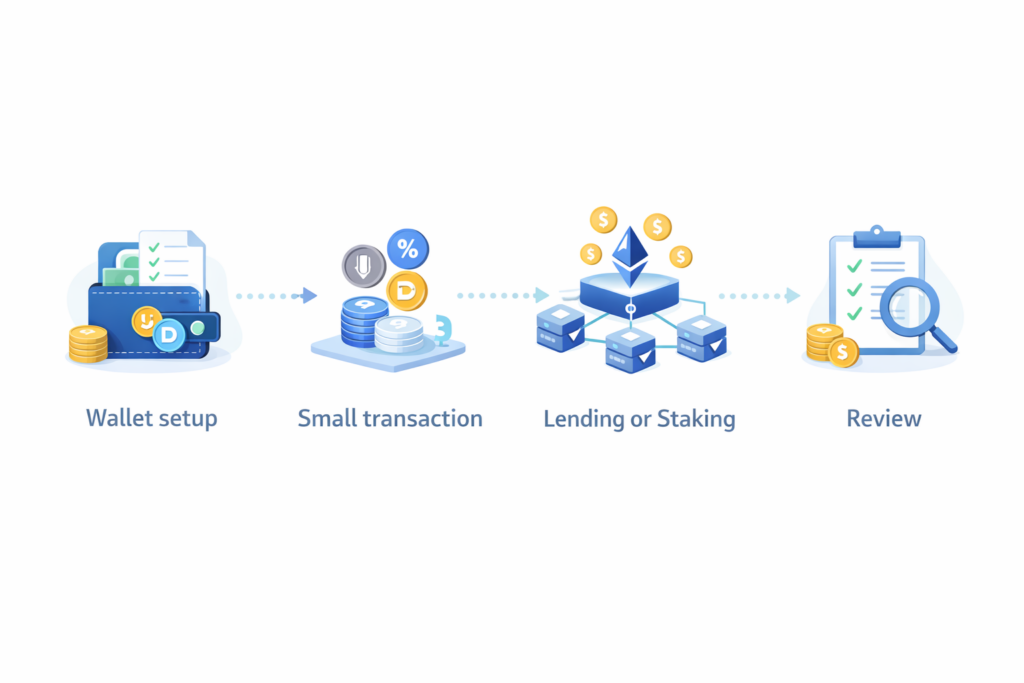
Day 1 to 2: Set up and practice
- Set up a wallet, back up the seed phrase offline.
- Send a small amount of crypto to cover fees.
- Do one tiny transaction to learn what signing feels like.
Day 3 to 4: Try one action Pick one:
- Lend a stablecoin amount you can afford to lock up for a week, or
- Stake a small amount (native or liquid, but not both).
Track what you did: date, amount, protocol, chain, and fees paid.
Day 5 to 7: Review and decide
- Check how much you earned and how fees affected it.
- Withdraw once, just to learn the exit flow.
- Only then consider a second action, like borrowing, and only with a wide safety buffer.
Learning the buttons matters. Most people skip this and pay for it later.
Avoid the biggest beginner mistakes: fake sites, unlimited approvals, and borrowing too much
A few mistakes show up again and again.
Red flags that should stop you
- Countdown timers pushing you to act fast.
- DMs offering “support,” “refunds,” or “recovery.”
- Any site asking for your seed phrase, ever.
- Wallet prompts to sign messages you don’t understand.
Token approvals in simple terms Before a protocol can move your USDC, you approve it. Many apps request unlimited approvals, which means the contract can move all of that token from your wallet in the future.
Limited approvals reduce blast radius. They’re not perfect protection, but they help.
Good habits:
- Approve only what you plan to use when possible.
- Re-check approvals later and revoke ones you don’t need anymore.
- Keep a separate wallet for “trying new apps” and another for long-term holdings.
Borrowing too much is the fastest way to lose collateral If you borrow near the limit, a normal price swing can liquidate you. If you borrow at a conservative level, you give yourself time to react.
DeFi doesn’t reward bravado. It rewards patience.
Conclusion
DeFi gets easier when you separate the big three actions. Lending earns interest by supplying assets to a pool. Borrowing gives you cash-like tokens by locking collateral, with liquidation as the penalty for getting greedy. Staking earns network rewards for securing a proof-of-stake chain, with extra risk if you choose liquid staking and stack yields.
Start small, stick to well-known protocols, and keep a wide buffer if you borrow. Learn the flows before chasing the highest APY. Pick one goal, earn yield on stablecoins, borrow carefully, or stake ETH, then test it with a tiny amount until it feels normal.
Read Also: Layer-2 Blockchains: Simple Guide for 2026
Disclaimer
The information provided on this website is published in good faith and for general informational and educational purposes only. It does not constitute financial, investment, trading, legal, or tax advice of any kind.
Cryptocurrencies and digital assets are highly volatile and involve substantial risk. Market conditions can change rapidly, and users may lose some or all of their invested capital. Any actions taken based on the information found on this website are strictly at the reader’s own risk.
References to cryptocurrencies, exchanges, wallets, tools, platforms, or strategies are shared solely for educational awareness and should not be interpreted as recommendations, endorsements, or professional advice.
Readers are advised to conduct their own research (DYOR) and seek guidance from a qualified financial advisor, tax consultant, or legal professional before making any financial or investment decisions.
Cryptocurrency laws, regulations, and taxation policies—particularly in India—may change over time. The content on this website is based on publicly available information at the time of publication and may not reflect the most recent legal or regulatory updates.
The website owner, authors, and contributors do not accept any liability for losses, damages, or consequences arising from the use of the information provided on this website.
Some content on this website may contain affiliate links. This means we may earn a small commission at no additional cost to you. This does not influence the accuracy, transparency, or integrity of the content.