
What Happens in a Bitcoin Halving? Simple Guide (Updated 2026)
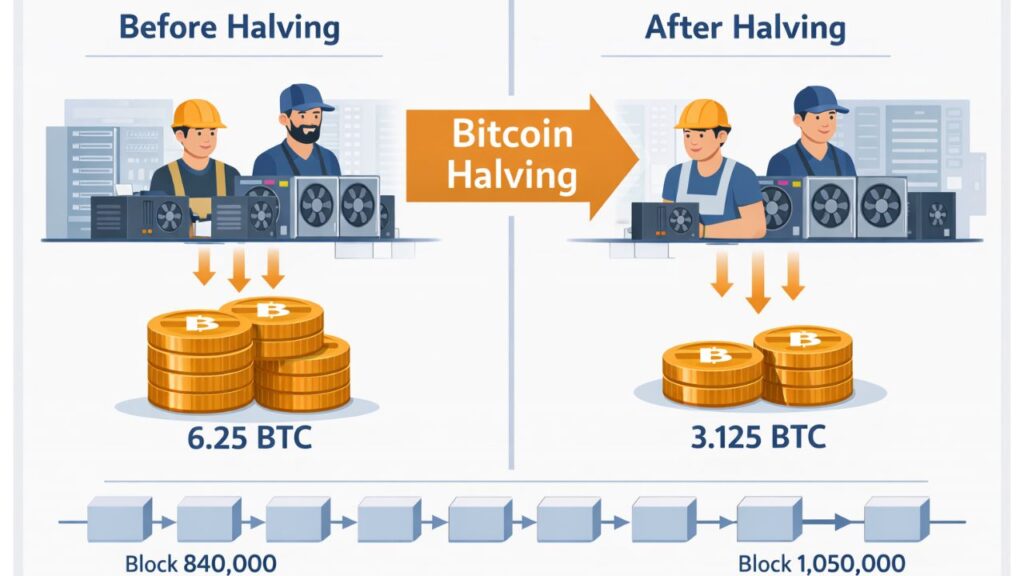
A Bitcoin halving is when the reward paid to Bitcoin miners gets cut in half.
That sounds small, but it touches everything around Bitcoin’s money supply: how fast new coins are created, how miners stay profitable, and how traders and long-term holders think about price. This guide explains what actually changes on halving day, why it matters, and what to watch as we head through 2026. It’s calm on purpose, because price can go up, down, or sideways after a halving.
Bitcoin halving explained in plain English
Bitcoin runs on a simple rhythm. About every 10 minutes, the network adds a new “page” of transactions to its public record.
Here are the key terms, without the buzzwords:
- Block: A batch of recent transactions bundled together.
- Miner: A person or company running machines that compete to add the next block.
- Block reward: The payment a miner gets for adding a valid block. It includes newly created bitcoin (the subsidy) plus transaction fees.
- 21 million cap: Bitcoin’s code sets a hard limit of 21 million BTC total. That’s why people call it scarce.
The halving is built into Bitcoin’s code and happens every 210,000 blocks (roughly every 4 years). No one votes on it. There’s no meeting, no central switch, and no “Bitcoin team” deciding the new reward.
A concrete example helps. In April 2024, the block reward subsidy dropped from 6.25 BTC to 3.125 BTC per block.
Why Bitcoin halves the reward in the first place
The main point is to slow new supply over time and keep issuance predictable.
Think of it like a paycheck that shrinks on a fixed schedule. If your paycheck gets smaller every few years, you can still get paid, but less new money enters your account each month. Bitcoin does something similar with new coin creation, which is why people compare it to a built-in, long-term inflation control.
This schedule also makes Bitcoin easier to model. You can estimate how much new BTC will be created next week, next year, and next decade, even if you can’t predict the price.
Where the new bitcoin comes from (and what does not change)
New bitcoin only comes from the block subsidy, the “new coins” part of the block reward. A halving cuts that subsidy, it does not touch existing coins.
What stays the same after a halving:
- The network still processes transactions.
- Block time still targets about 10 minutes on average.
- People can still buy, sell, and hold BTC the same way.
- Your BTC balance doesn’t get cut in half. Only new issuance changes.
So the halving is a protocol event first, then a market event second.
What happens during a Bitcoin halving day (step by step)
A halving is less like a fireworks show and more like a scheduled change in a machine’s settings. The big on-chain change is simple: the next block pays less new BTC.
Here’s what it looks like in real time.
Before the halving: miners, exchanges, and market watchers track an estimated countdown. The exact moment can’t be pinned to a calendar, because block times vary.
At the halving block: one specific block height triggers the rule change. The next block reward subsidy is automatically cut in half.
After the halving: the network keeps running. Price and volatility, if they show up, come from people reacting, not from extra code changes.
The block reward is cut 50% at a specific block height
Halvings happen at block heights, not guaranteed dates. Dates are estimates based on average block production.
Recent halving schedule, with the numbers that matter:
- Nov 28, 2012 (block 210,000): 50 BTC to 25 BTC
- Jul 9, 2016 (block 420,000): 25 BTC to 12.5 BTC
- May 11, 2020 (block 630,000): 12.5 BTC to 6.25 BTC
- Apr 20, 2024 (block 840,000): 6.25 BTC to 3.125 BTC
Sources sometimes disagree by a day on older events (time zones and reporting), but the block heights are the clean “truth” since they’re recorded on-chain.
The next halving is expected around April 2028 at block 1,050,000, when the subsidy should drop from 3.125 BTC to 1.5625 BTC. The date can shift because the network doesn’t produce blocks on a perfect timer.
Miners feel the squeeze, and the network adjusts
For miners, a halving is an instant revenue cut in BTC terms. Unless the BTC price rises enough, or transaction fees rise enough, miners make less money for the same work.
What can happen next:
- Some miners shut off older, less efficient machines.
- Hash rate can dip for a while, then recover as the strongest miners keep running.
- Bitcoin’s difficulty adjustment helps the system adapt by re-tuning how hard mining is, aiming to keep blocks near the 10-minute average.
Over the long run, transaction fees matter more. Each halving reduces the subsidy, so fees become a bigger slice of miner revenue, especially during busy periods when users compete to get into blocks.
Why halvings move the market (and what history really shows)
The halving changes supply mechanics. Price is set by buyers and sellers, so it also depends on demand, liquidity, rates, risk appetite, and news.
A helpful way to think about it: the halving is a supply change that happens on one day, but any price response often plays out over months, and rarely in a straight line.
Supply shock basics: fewer new coins sold each day
Many miners sell part of their mined BTC to pay for electricity, staff, rent, and debt. When issuance drops, there may be less steady sell pressure coming from mining.
If demand stays the same while new supply falls, upward pressure can build. But “can” is doing a lot of work there. If demand drops, or if large holders sell, price can still fall after a halving.
Past halving cycles in one quick table-style summary
This table is a mental model, not a promise. Each cycle had its own macro backdrop.
| Halving | Date (common) | Block | Subsidy change | What price often did later |
|---|---|---|---|---|
| 2012 | Nov 28, 2012 | 210,000 | 50 to 25 | Strong move in the following year, with big swings |
| 2016 | Jul 9, 2016 | 420,000 | 25 to 12.5 | Rally later, plus sharp pullbacks along the way |
| 2020 | May 11, 2020 | 630,000 | 12.5 to 6.25 | Large run-up later, with periods of fear and fast drops |
| 2024 | Apr 20, 2024 | 840,000 | 6.25 to 3.125 | Volatility around the event, longer-term outcome depends on demand |
Two practical takeaways show up again and again: markets often move before the halving, and pullbacks are normal even inside a broader uptrend.
What is different after the 2024 halving heading into 2026
By 2026, Bitcoin is not a small niche market anymore. That changes how a halving can echo through price.
A few realistic factors to keep in mind:
- More big-money access: Spot Bitcoin ETFs in major markets (including the US in 2024) made it easier for some investors to buy exposure without holding coins directly. That can affect demand patterns.
- Tougher mining competition: As the subsidy shrinks, efficient operations tend to gain share, and weaker ones can get pushed out.
- Fees matter more: Over time, fees are a larger part of miner revenue, which ties miner health more closely to on-chain activity.
All of this can change the speed and size of any post-halving move. It can also change what “normal” volatility looks like.
Simple 2026 takeaway: how to use halving info without getting wrecked
A halving is useful context, not a trading signal by itself. If you treat it like a guaranteed payday, you’ll probably make rushed decisions at the worst time.
Common myths to ignore
Myth: “Price must go up after the halving.”
Reality: supply drops, but demand can drop too. The market can also price in expectations early.
Myth: “It happens every 4 years on the same day.”
Reality: it’s block-based. The date is always an estimate until the block arrives.
Myth: “The halving changes the 21 million cap overnight.”
Reality: the cap stays the same. The halving only changes the speed of new issuance.
Short-term price moves are often driven by headlines, liquidations from leverage, and sudden fear or greed, not by the halving mechanics alone.
Beginner-friendly ways to follow a halving
You don’t need a wall of charts to stay grounded. Simple habits work.
- Track the next halving block height (1,050,000) and treat the date as a range, not a deadline.
- Watch a few network signals at a high level: hash rate, difficulty, and average fees.
- Set a time horizon that fits the halving cycle, and don’t bet rent money on a one-week move.
- Use basic risk tools: keep position sizes sane, avoid heavy leverage, and write down what would make you buy, hold, or sell before volatility hits.
Conclusion
A Bitcoin halving cuts the flow of new BTC in half, puts pressure on miners, and can influence price over months as supply and demand rebalance. The only guaranteed change is the reward drop at a specific block, everything else is the market reacting in real time.
If you want one practical next step, bookmark the next halving estimate (block 1,050,000, expected around April 2028) and keep learning the basics. In 2026, patience and risk control usually beat hype.
Read Also: AI Crypto Tokens in 2026: Hype or Smart Investment?
Disclaimer
The information provided on this website is published in good faith and for general informational and educational purposes only. It does not constitute financial, investment, trading, legal, or tax advice of any kind.
Cryptocurrencies and digital assets are highly volatile and involve substantial risk. Market conditions can change rapidly, and users may lose some or all of their invested capital. Any actions taken based on the information found on this website are strictly at the reader’s own risk.
References to cryptocurrencies, exchanges, wallets, tools, platforms, or strategies are shared solely for educational awareness and should not be interpreted as recommendations, endorsements, or professional advice.
Readers are advised to conduct their own research (DYOR) and seek guidance from a qualified financial advisor, tax consultant, or legal professional before making any financial or investment decisions.
Cryptocurrency laws, regulations, and taxation policies—particularly in India—may change over time. The content on this website is based on publicly available information at the time of publication and may not reflect the most recent legal or regulatory updates.
The website owner, authors, and contributors do not accept any liability for losses, damages, or consequences arising from the use of the information provided on this website.
Some content on this website may contain affiliate links. This means we may earn a small commission at no additional cost to you. This does not influence the accuracy, transparency, or integrity of the content.