
Layer-2 Blockchains Explained: Why They Matter in 2026
If you have heard of Bitcoin or Ethereum, but never of Layer-2, you are not alone. Many people in India buy a little crypto, then see strange terms like L2, rollups, and gas fees, and feel lost.
Here is the simple truth: popular blockchains get crowded. When too many people try to use them, they become slow and costly. A simple transfer or game move can start to feel like standing in a long line in front of a bank counter.
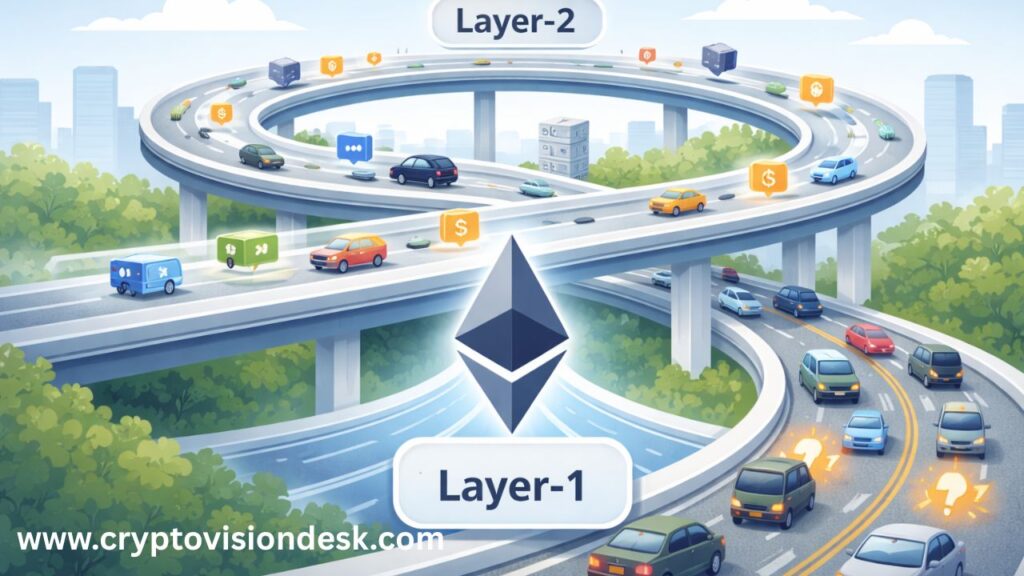
Layer-2 blockchains are like adding flyovers and service roads above a packed highway. The main road is still there, but a lot of the traffic moves to these extra paths, so everyone travels faster and spends less on fuel.
In 2025, most activity linked to Ethereum already happens on Layer-2 networks, not on the main Ethereum chain. In 2026 this will matter even more for regular users, small investors, and app builders, including beginners in India.
This guide will explain what Layer-2 is, why it exists, simple examples, how it works without heavy tech, which projects you will keep hearing about, and what to watch in 2026.
What Is a Layer-2 Blockchain in Simple Words?
A Layer-2 blockchain is a network that sits on top of a main blockchain like Ethereum. It uses the security of that main chain, but handles most transactions in its own faster and cheaper system.
You can think of it as a helper road that stays connected to the main highway at several points. You still trust the main highway for safety rules, but you move separately on the helper road most of the time.
Layer-2s are built for the same users and apps as Ethereum, but with less waiting and lower fees.
First, a quick recap: What is a Layer-1 blockchain like Ethereum or Bitcoin?
Layer-1 is the base blockchain. It is the main record book where all final transactions are stored.
Popular Layer-1 blockchains include:
- Bitcoin
- Ethereum
- Solana
- Polygon PoS (many Indians know it as “Polygon chain”)
Key traits of Layer-1 chains:
- Very secure, because many computers check each block
- Decentralized, no single company fully controls it
- Limited capacity, often just a few dozen transactions per second
- Can get slow and expensive when many people use it at the same time
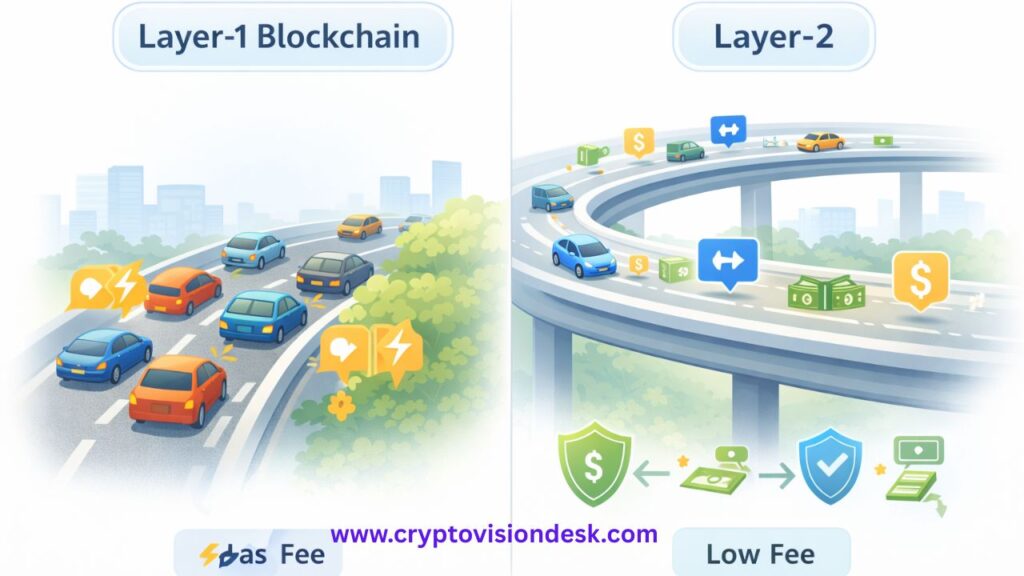
When Ethereum is busy, fees can jump to several dollars, sometimes even 10 to 100 dollars for a single transaction, while the network still handles only around 15 to 30 transactions per second.
Easy analogy: Layer-2 as a flyover above a crowded road
Imagine a busy road in Mumbai, Delhi, or Bengaluru during office hours. Cars hardly move. Honking everywhere. That is the main blockchain.
To fix this, the government builds a flyover or metro line above the road. Many people move to this new route. The main road gets some relief, and travel becomes smoother for everyone.
- The crowded road is the Layer-1 blockchain.
- The flyover or metro is the Layer-2 blockchain.
People still start and end their journey in the same city. In the same way, Layer-2 users still rely on Ethereum for security and final settlement, but most of their activity happens on the faster layer above.
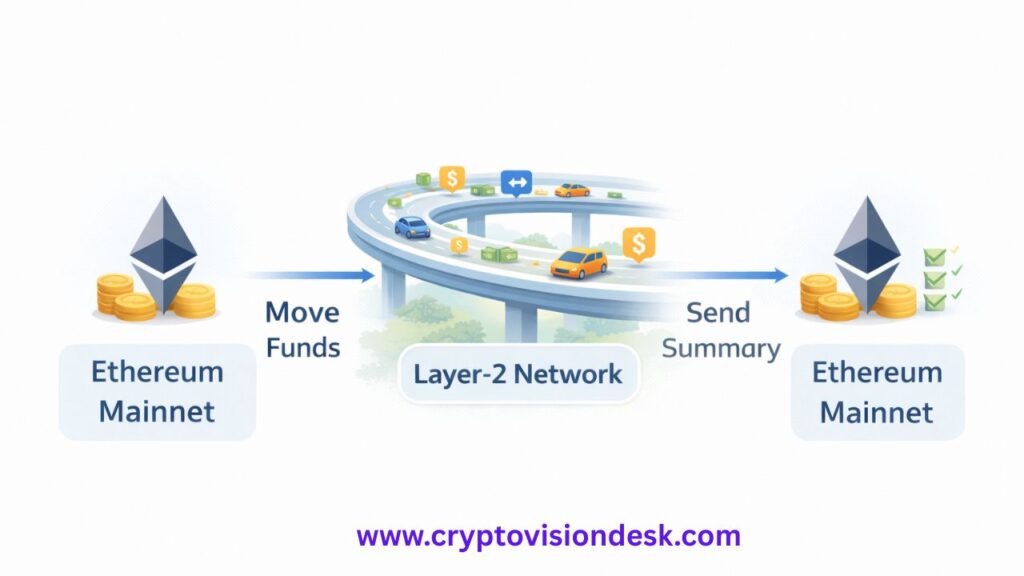
Layer-2s move many small and frequent transactions off the main chain, then report the summary back, so the main road stays less crowded.
Formal but simple definition of a Layer-2 blockchain
A Layer-2 blockchain is a network built on top of a main chain, like Ethereum, that processes many transactions separately, then sends a combined summary back to the main chain.
It keeps the security of the Layer-1, while giving higher speed and lower cost.
Key ideas:
- Built on top of a base chain
- Depends on the main chain for security and final records
- Designed to handle more transactions per second
- Targets much lower fees for users and apps
Why Do We Need Layer-2 Blockchains at All?
If main blockchains work already, why add another layer? Because real usage brings real pressure.
Think about small transfers, gaming, NFT mints, DeFi, and experiments by students and developers in India. When all these activities run on a single main chain, the line becomes long and the ticket price goes up.
Ethereum mainnet often has high gas fees during peak hours, while Layer-2 networks process far more activity at a fraction of the cost. In 2025, L2s together handle the majority of Ethereum-related transactions and hold billions of dollars in total value locked.
Layer-2s help crypto move from a “rich users only” system to something more open for normal budgets.
The big problem: slow networks and high gas fees when everyone uses crypto
Think about a crowded local train in Mumbai at rush hour. Getting in takes effort, and you may miss a train because it is too full. That is what happens to Ethereum when activity spikes.
- Each block can hold only a limited number of transactions
- When more people compete for space, fees rise
- Simple actions like sending 10 dollars can cost 5 dollars or more
- Crowds make it hard to use crypto for small, daily tasks
This is bad for:
- Daily payments and remittances
- On-chain games where you click often
- NFT collectibles and social apps
- People with small amounts who hate paying high fees
How Layer-2 makes transactions faster and cheaper
Layer-2 uses a smart trick: it groups many user actions together, then posts them to Ethereum as one bundle.
Picture a bus versus many auto-rickshaws:
- If 40 people take 40 autos, the road is jammed and fuel cost is high
- If 40 people take one bus, the road is clearer and total cost is much lower
Layer-2 works like the bus. It:
- Collects many transactions
- Processes them off the main chain
- Sends one combined update to Ethereum
This reduces:
- The load on Ethereum
- The gas fee per user
- The waiting time for confirmation
Modern Layer-2 networks can handle thousands of transactions per second. Fees are often 90 to 95 percent cheaper than using Ethereum mainnet directly, sometimes less than 1 rupee per transaction.
Real-world benefits for users in India
For beginners in India, Layer-2 networks help in very direct ways:
- Small transfers: Send money to a friend without giving half of it to gas
- On-chain games: Play games or try Web3 apps without worrying each click costs a lot
- NFTs and collectibles: Mint or trade low-price NFTs cheaply
- DeFi with low capital: Try lending, swapping, or saving with small amounts
- Education and testing: Experiment and learn by doing, without burning your budget on fees
Cheaper fees mean more people can try these tools. The focus shifts from “Is this gas fee worth it?” to “Is this app useful for me?”
How Do Layer-2 Blockchains Actually Work? (Without Heavy Tech)
Layer-2s come in different types, but they share one basic idea: handle most work off-chain, then settle on-chain.
You do not need to understand every detail to use them. It helps to know the big picture and a few common terms.
The basic idea: process off-chain, settle on-chain
Here is a simple journey of a Layer-2 transaction on Ethereum:
- You move funds from Ethereum mainnet to a Layer-2 network.
- Your funds appear on the L2, and you start using apps there.
- You make many cheap, fast transactions inside that L2.
- The L2 bundles and posts proof of your activity back to Ethereum.
- When you want, you withdraw funds back to mainnet or to an exchange.
Security comes from the fact that final settlement and data live on Ethereum, even if most steps happen on the L2.
Optimistic rollups explained in plain English
Optimistic rollups are a popular type of Layer-2. They work on a simple belief: by default, we assume transactions are correct, but there is a time window to challenge any wrong ones.
If someone posts a bad bundle, others can spot it and prove it is wrong. That keeps everyone honest.
Well-known optimistic rollup networks include:
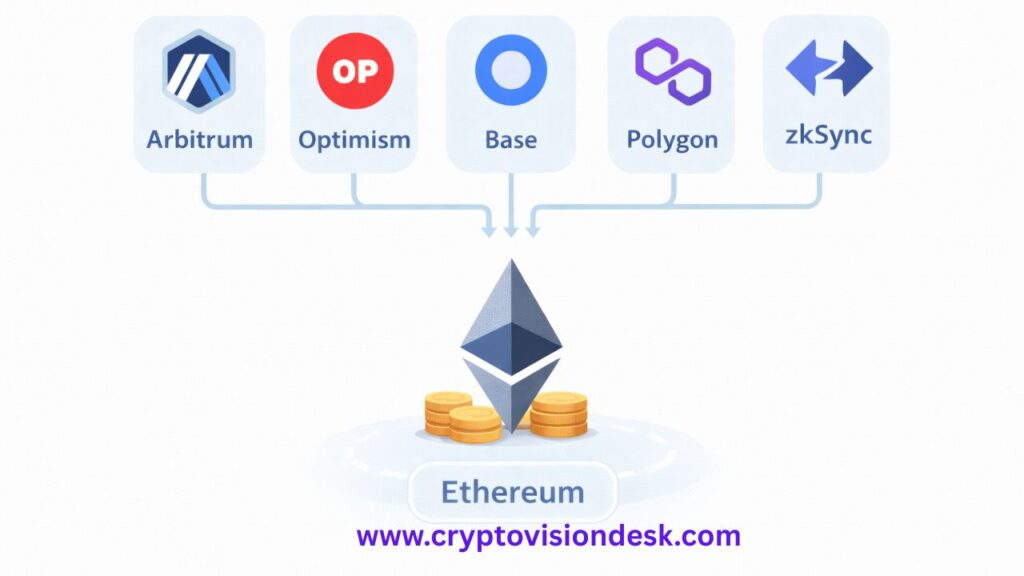
- Arbitrum
- Optimism
- Base (built using the Optimism tech stack)
For users:
- Transactions feel fast and cheap
- Most actions confirm in seconds
- Withdrawals back to Ethereum can take longer because of the challenge period
Many top DeFi apps and NFT platforms have versions on these networks, so the experience is similar to Ethereum, just with lower gas.
zk-rollups and why everyone talks about them now
zk-rollups use zero-knowledge proofs, a type of advanced math. You can think of it like this: a student proves to the teacher that all answers in the notebook are correct without showing each answer one by one.
The network proves a large batch of transactions is valid with a small proof. Ethereum checks that proof instead of rechecking each transaction.
Examples include:
- zkSync
- StarkNet
- Polygon zkEVM and other Polygon zk-based L2s
User benefits:
- Strong connection to Ethereum security
- Very low fees
- Often faster exits compared to optimistic rollups
Because of these traits, many developers expect zk-rollups to grow fast in 2026.
Sidechains and app-specific Layer-2 networks
Some networks sit next to Ethereum rather than directly on top of it.
Sidechains and app-specific chains:
- Have their own validators and security rules
- Often connect to Ethereum through bridges
- Can be tuned for games, social apps, or a single large project
Examples:
- Polygon PoS, a well-known chain for Indian users
- Game-focused chains built for NFTs and in-game items
- App-specific rollups where one app or company runs its own L2
From a beginner’s view:
- Each network has different trade-offs in speed, cost, and security
- Try to stick with chains and bridges that are widely used and well reviewed
Popular Layer-2 Projects You Will Hear About in 2026
Several L2 networks already dominate daily use. They handle billions in total value locked and large chunks of Ethereum activity.
Here are some names you will keep seeing in 2026.
Arbitrum: the leading DeFi Layer-2 today
Arbitrum is currently one of the largest Ethereum Layer-2 networks by total value locked and user activity.
What matters for you:
- Many top Ethereum DeFi apps also run on Arbitrum
- Fees are low, so small swaps or deposits feel more reasonable
- It supports thousands of transactions per second
When a lot of money and well-known apps sit on a network, it signals that many builders and users trust it for real work.
Optimism and the Superchain vision
Optimism is another major optimistic rollup. It not only runs its own chain, but also provides the OP Stack, a set of tools to build other L2s.
One key idea here is the Superchain. Many chains built with the same stack can work together more smoothly, almost like districts in the same city.
For users, this can mean:
- Easier movement between different L2s that share this tech
- Similar wallet experience across apps
- Strong focus on long-term infrastructure and public goods
Base, the L2 from Coinbase, uses this stack, which helps connect new users from exchanges to the broader L2 world.
Base: Coinbase’s user-friendly Layer-2
Base is an optimistic rollup supported by Coinbase, one of the largest global exchanges.
Reasons beginners care:
- Onboarding from bank accounts or fiat ramps is simple for many users
- Interface feels friendly, since Coinbase focuses on new users
- In 2025, Base quickly became one of the top L2s by TVL and daily transactions
Base also hosts a fast-growing set of apps, from DeFi to social projects, showing that exchanges see L2s as the future for everyday crypto use.
Polygon, zkSync, and other rising zk-rollup ecosystems
Polygon is moving from only a sidechain (Polygon PoS) to a family of zk-based Layer-2s. This shift aims to combine its large community with stronger security tied to Ethereum.
zkSync and StarkNet also focus heavily on zero-knowledge tech. Many new projects, especially in gaming, NFTs, and DeFi, are choosing zk-rollups first because they offer:
- Very low fees
- Strong security proofs
- Good support for complex apps
For beginners, this means more apps that “just work” at low cost, running behind the scenes on zk-powered L2s.
Why Layer-2 Blockchains Will Matter Even More in 2026
The trend is clear. Ethereum is becoming a base settlement layer, while daily user activity moves to L2.
In 2026, you can expect:
- Cheaper and smoother crypto apps
- Better wallets that hide most complexity
- More real-world assets and services on Layer-2
As fees drop and app quality improves, using an L2 may feel as normal as using UPI today.
Ethereum upgrades that boost Layer-2 performance
Ethereum itself is changing to support this multi-layer future.
Important upgrades:
- The Dencun update, launched in 2024, added special “blob” space so Layer-2s can post data to Ethereum at much lower cost.
- Future work on data availability, often grouped under the term danksharding, aims to give L2s even more room to store and prove their data cheaply.
Think of it as the main highway adding special lanes only for buses. Those buses are the Layer-2 networks. With more space, they carry more people smoothly and at lower cost.
More apps, more users, and more real-world use cases
As L2 costs stay low, more practical ideas become possible:
- Micro-payments and subscriptions
- Gaming with real item ownership
- Event ticketing with verifiable passes
- On-chain identity and reputation
- Tokenized real-world assets like bonds and funds
In 2025, some institutions already started using L2s to issue tokenized funds and bonds. As serious players move to L2, everyday users benefit from more polished products and smoother experiences.
Better user experience: wallets, bridges, and on-ramps
By 2026, you may not even need to think about which network you are on.
Wallets will:
- Auto-select the best network in the background
- Show your combined balances clearly
- Route transactions across L2s without you learning every detail
Bridges will become safer and easier to use. On-ramps in India, such as UPI-based or bank transfer options inside exchanges and apps, may let you deposit directly to an L2 address.
For beginners, the goal is simple: crypto apps should feel like any other good mobile app, while the Layer-2 technology stays hidden behind the scenes.
Risks, trade-offs, and how to stay safe on Layer-2
Layer-2s are powerful, but they are not magic. There are risks.
Common concerns:
- Smart contract bugs in L2 code
- Bridge hacks, where funds move between chains
- Centralized control in some networks
- Confusing interfaces that lead to user mistakes
Simple safety tips:
- Use trusted wallets and well-known exchanges
- Always double-check website links and contract addresses
- Start with small amounts while you learn
- Keep recovery phrases offline and private
- Remember that crypto is risky and prices can change quickly
This is not investment advice. Treat L2s as new technology to understand first, before thinking about money decisions.
Conclusion
Layer-2 blockchains are like flyovers for crowded crypto highways. They sit on top of main chains like Ethereum, handle most of the traffic, and send clean summaries back, so everyone enjoys higher speed and lower cost.
They exist because main blockchains alone cannot cheaply support global usage. By 2025, most Ethereum activity already lives on L2, and in 2026 these networks will shape how regular people, from Indian students to small business owners, interact with Web3 apps.
If you are a beginner, your best next step is not to rush into tokens. Instead, learn how L2s work using testnets, small trial amounts, and trusted educational resources. Focus on understanding the tools, not chasing quick gains.
Everyday crypto is moving to Layer-2. Over the next few years, many apps you try will quietly run on these networks, even if the interface never says the word “rollup.”
Disclaimer: This content is for educational purposes only.
Read Also: Best Crypto Wallets for Beginners 2026 | Hot vs Cold Guide