
Best Stablecoins in 2026 (and Which Ones Are Actually Safe)
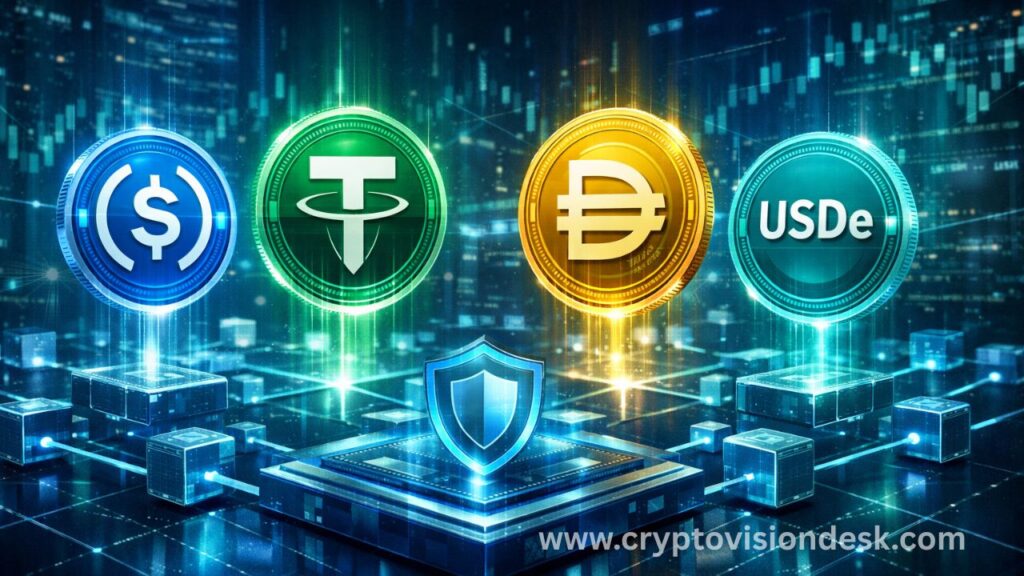
Stablecoins are digital dollars. You can trade with them, park cash between moves, send money fast, or use them inside DeFi without touching a bank wire.
The problem is that “stable” doesn’t always mean “safe.” In 2026, stablecoins are bigger than ever (the sector hit about $283.7 billion in late 2025), but the risks are still real. Some coins are backed by simple assets like cash and short-term US Treasury bills. Others depend on crypto collateral, lending, or hedging strategies that can break under stress.
This is for people holding stablecoins longer than a trade.
This guide does two things: it shows a simple way to judge stablecoin safety, then walks through the best stablecoins in 2026 by type, with clear tradeoffs. Nothing here is magic. It’s more like choosing where to store water, a sealed bottle is different from a rain barrel on a windy day.
Key Takeaways
- In 2026, the safest stablecoins are the ones with simple, verifiable reserves (cash and short-term US Treasuries) and a clear $1 redemption process.
- Stablecoin safety depends on reserves, redemption rules, and operational risk (banks, custodians, smart contracts, bridges, and exchanges).
- USDC fits safety-first holding, USDT fits high-liquidity trading, DAI fits DeFi users who accept smart contract and liquidation risk, USDe fits users who accept strategy and derivatives risk.
- Centralized stablecoins can freeze funds, and even strong reserves still carry banking and custody risk.
- Repeated depegs, unclear reserves, confusing redemptions, thin liquidity, and “high yield with no clear source” are practical red flags.
What makes a stablecoin safe in 2026? A simple safety checklist

A stablecoin is only as safe as its reserves, its rules, and its plumbing (the banks, custodians, smart contracts, and exchanges that keep it running).
Before you hold any stablecoin for more than a quick trade, run this checklist:
- Can you verify what backs it? Look for clear reserve breakdowns and frequent reports.
- Can you redeem it for $1 in a normal way? Safety improves when redemptions are real, not just a promise.
- Who controls it? Some issuers can freeze tokens or block addresses.
- Where can it break? Banks can fail, custodians can freeze, bridges can get hacked, and smart contracts can have bugs.
- How has it behaved in stress? A stablecoin that has traded below $1 before can do it again.
No stablecoin checks every box perfectly. The goal is to match the coin to your use case, then limit your exposure.
Reserves you can verify: cash and short-term U.S. Treasuries beat vague backing
When people say “1:1 backed,” they mean the issuer claims it holds $1 of assets for every 1 token. That’s the basic promise.
What matters is what that $1 is made of.
Cash and short-term US Treasury bills are easier to understand than a basket of “other assets.” They’re also easier to sell quickly to meet redemptions. In plain terms, this is the difference between keeping your rent money in a checking account versus keeping it in a drawer full of IOUs.
What to look for on a stablecoin’s official transparency page:
Clear categories: cash, Treasury bills (short maturity), repos, and any “other” bucket broken down in detail.
Simple custody story: reserves held with well-known custodians and regulated financial partners.
Regular third-party attestations or audits: an outside firm checks the numbers. (Always read what the report actually covers. Some reports check balances on a date, not every day in between.)
If a project can’t explain its reserves in a way you’d understand in 60 seconds, treat it as higher risk.
Real risks people miss: issuer freeze power, banking exposure, smart contract bugs, and depeg history
Even with strong reserves, stablecoins can fail in ways people don’t think about until it’s too late.
Issuer control (freeze risk)
Many popular stablecoins are centralized. That often means the issuer can freeze tokens at certain addresses. This can help with fraud, but it also means your access can be restricted if you trip compliance rules or use the wrong platform.
Banking and custody risk
Stablecoins that hold dollars and Treasuries still depend on banks and custodians. If a banking partner has an issue, redemptions can slow down. You might still be “whole” on paper, but you can be stuck in the meantime.
Blockchain, bridge, and wallet risk
The coin can be safe, but your route to using it might not be. Bridges are a common weak point. A hacked bridge can turn “safe reserves” into “I can’t move my funds.”
Smart contract and DeFi risk
Decentralized stablecoins and synthetic designs rely on code and market mechanics. Code can have bugs. Liquidation systems can get overwhelmed in fast crashes.
Depeg risk (price slipping below $1)
A depeg is when a “$1 coin” trades at less than $1, even briefly. Example: you try to sell 1 stablecoin and the market only pays $0.97. That gap is your risk showing up in real time.
If your stablecoins are meant to act like cash, treat any repeated depeg history as a serious warning, even if the peg later recovers.
Best stablecoins in 2026, ranked by safety profile (and who each is for)
In January 2026, market trackers show the category is still dominated by USDT and USDC, with newer entrants growing fast. Size alone isn’t safety, but it does affect liquidity and how a coin behaves during panic.
Here’s a practical safety profile view:
| Stablecoin | Best for | Safety profile (plain English) | Biggest downside to watch |
|---|---|---|---|
| USDC | Long-term holders who want simpler backing | Built around fiat-style reserves and transparency norms | Centralized control, depends on banks |
| USDT | Traders who need deep liquidity | Huge adoption and liquidity support the peg | Trust depends on issuer practices and reporting |
| DAI | DeFi users who want fewer single-issuer controls | Overcollateralized design, on-chain mechanics | Smart contract and liquidation risk |
| USDe | Users chasing yield who accept complexity | Hedged, synthetic structure can scale fast | Strategy and derivatives risk in stress |
| USD1 | People testing newer fiat-backed options | Fiat-backed design with named custodian | New-coin risk, reputation and concentration concerns |
| FDUSD | Users who need a specific exchange pair | Can be convenient where it’s supported | Platform concentration, redemption clarity |
The sections below explain what that means in real life.
USDC: best all-around pick for safety-minded users
Best for: holding stable value between trades, storing spending money on-chain, paying for crypto services, and moving dollars across chains with less drama.
USDC is widely viewed as the “clean and simple” style of stablecoin: designed around fiat-style backing (think cash and short-term government debt), with a stronger focus on transparency norms than many competitors.
Why people consider it safer:
- The model is meant to be straightforward: reserves that should hold value even in rough markets.
- It’s broadly integrated across major apps, wallets, and on-chain markets, so you usually have multiple exits if one venue gets messy.
Downside to watch: USDC is centralized. That means policy and compliance decisions can affect access. It also relies on the traditional banking system for custody and redemption, so bank-side problems can still create friction.
Who should avoid it? If you need a stablecoin that can’t be frozen by an issuer, this isn’t that.
USDT: biggest and most liquid, but trust depends on the issuer
Best for: active trading, exchange liquidity, and moving in and out of crypto quickly.
USDT is still the giant. January 2026 snapshots place it around $140 to $173 billion in market cap, and it accounts for a large share of stablecoin trading volume. That matters because liquidity is a form of safety when markets turn ugly. If you can sell fast at close to $1, you can manage risk.
Why USDT can be “safe enough” for many users:
- It’s accepted almost everywhere.
- Deep liquidity often helps it hold its peg during fast moves.
Downside to watch: with USDT, the key question is always trust in the issuer and the quality of disclosures. It’s commonly described as backed by a mix that includes cash and US Treasuries, plus other assets. The more complex the reserve mix, the more you should care about transparency and redemption behavior.
Practical guidance: USDT can be great for short-term liquidity. If you’re very cautious and you’re treating stablecoins like savings, it can make sense to keep less of your long-term stable balance in the coin where your comfort depends most on issuer reporting.
DAI: decentralized stablecoin with smart contract risk
Best for: DeFi users who want a stablecoin that doesn’t rely on a single company holding a pile of dollars.
DAI is built differently. Instead of “a company holds dollars,” DAI is minted through an overcollateralized system, where users lock crypto assets in smart contracts and borrow DAI against them. If collateral drops too far, the system can liquidate positions to protect the peg.
Why people like DAI from a safety standpoint:
- No single issuer is meant to control redemptions the way a centralized stablecoin does.
- It’s native to DeFi and widely used as a core building block.
Downside to watch: the risk shifts from banks to code and market mechanics.
- In a sharp crash, liquidations can spike.
- Smart contracts can have bugs.
- Governance decisions can change risk settings over time.
DAI can be a solid choice if you already live on-chain and understand what liquidation risk feels like. If you just want “digital cash,” it may be more moving parts than you want.
USDe: higher-yield design, higher complexity risk
Best for: experienced users who understand stablecoin strategy risk and want exposure to a synthetic, hedged model.
Ethena’s USDe has grown fast, reaching about $14.4 billion in January 2026 snapshots. Its appeal is simple to explain: the design aims to produce yield using a hedged approach, rather than only relying on a pile of cash and T-bills.
The upside:
- It can scale quickly because it doesn’t require the same banking rails per token as a traditional fiat-backed coin.
- It’s designed to be used in on-chain markets where yield matters.
Downside to watch: complexity. Hedging systems can break in rare market conditions, especially when funding rates flip, liquidity dries up, or counterparties pull back. Even if it holds $1 most days, the risk profile is closer to a strategy fund than a plain stored-value token.
Clear warning: don’t treat USDe like a bank deposit. Size and popularity don’t remove strategy risk.
USD1 and FDUSD (smaller options): when they can make sense, and what to check first
Best for: niche use cases, testing, and situations where a specific platform supports them well.
USD1 (World Liberty Financial USD) launched in March 2025 and reached about $2.1 billion by January 2026 snapshots. It’s described as fiat-backed, with US dollar reserves and Treasury bonds held with BitGo as custodian. On paper, that’s the kind of backing many safety-focused users want.
Still, two practical risks come with newer stablecoins:
- New-coin risk: shorter track record through stress events.
- Reputation and concentration risk: public perception, partnerships, and where liquidity lives can matter more than people expect.
If you’re considering USD1, watch consistency over time: reserve reporting quality, redemption clarity, and how it trades during volatility.
FDUSD often shows up where exchange pairs matter. If most of the liquidity and use comes from one venue, your risk can become “platform risk” even if the coin itself is fine.
Before holding either for more than convenience, check three things:
Redemption path: can you reliably redeem, or are you stuck selling on the market?
Liquidity depth: thin liquidity can turn a small problem into a big haircut.
Concentration: if one exchange is the whole ecosystem, treat your exposure like you’re exposed to that exchange.
How to hold stablecoins safely: reduce risk without overthinking it
You don’t need a complicated setup to be safer. Most stablecoin blowups (or painful losses) come from a few repeat mistakes: keeping everything on one exchange, chasing yield you don’t understand, or holding one coin as if it’s insured cash.
Pick the right home: exchange wallet vs self-custody wallet vs on-chain DeFi
Where you hold a stablecoin changes your risk more than people think.
Exchange wallet: easy, fast trading, simple conversions. The tradeoff is platform risk. If withdrawals pause, your “stable” coin isn’t very useful.
Self-custody wallet: you control the keys. You reduce exchange risk, but you must protect your seed phrase and avoid signing shady transactions. A basic hardware wallet can help.
On-chain DeFi: more ways to earn and use collateral, but you add smart contract risk, oracle risk, and sometimes bridge risk.
A simple rule that holds up: the safer the goal, the simpler the setup. If this money is for rent, taxes, or a near-term purchase, keep it in the least fragile place you can.
Diversify and set limits: a simple plan for short-term cash, trading, and DeFi
Diversifying stablecoins can feel silly because they’re all “$1.” It’s not about price, it’s about failure modes.
A practical approach many cautious users follow:
- Keep most stablecoin balances in one or two coins with simpler reserve stories and strong liquidity.
- Keep smaller amounts in coins with higher complexity (decentralized or synthetic) only if you understand the risks.
- Keep some funds off-chain in a bank if you need guaranteed bill pay and consumer protections.
Also set a personal rule for exchange exposure. Example: only keep what you plan to trade this week on an exchange, not your full cash pile.
Red flags to avoid before you buy: unsustainable yields, unclear reserves, blocked redemptions, and thin liquidity
Stablecoin risk usually waves at you first. People just ignore it.
Watch for:
Unclear reserves: vague “backed by assets” language with no clean breakdown.
No reputable reports: nothing current, or reports that don’t answer basic questions.
Blocked or confusing redemptions: if you can’t explain how $1 comes back to you, slow down.
Big yields with no clear source: if the return sounds like free money, the risk is hidden somewhere.
Frequent small depegs: a coin that often trades at $0.99 can trade at $0.95 when panic hits.
Thin liquidity: low volume markets can trap you during a sell-off.
When in doubt, check the issuer’s official reserve and transparency pages, then compare that to how the coin trades across major venues.
Frequently Asked Questions About the Safest Stablecoins in 2026
What makes a stablecoin “safe” in 2026?
A stablecoin is safer when you can verify what backs it, redeem it for $1 through a normal process, and understand who controls it. It also needs strong operational plumbing, including banks, custodians, smart contracts, and bridges that do not fail under stress. Past behavior matters too, a coin with depeg history can depeg again.
Are USDC and USDT both safe stablecoins?
They can be “safe enough” for many use cases, but they have different risk profiles. USDC is positioned as simpler and more transparent, with reserves designed to hold value in rough markets, but it is centralized and depends on banks. USDT has the deepest liquidity and broad acceptance, which often supports the peg during panic, but user confidence depends more on issuer practices, reserve clarity, and redemption behavior.
Why do stablecoins depeg if they are “$1 backed”?
A depeg happens when the market price drops below $1, even if the issuer claims 1:1 backing. This can occur during panic selling, slow redemptions, banking or custody issues, thin liquidity, or fear about reserve quality. In DeFi and synthetic designs, fast market moves and liquidation stress can also cause slippage below $1.
Is DAI safer than fiat-backed stablecoins?
DAI removes some single-issuer control because it is minted through an overcollateralized, on-chain system. The tradeoff is that risk shifts to smart contracts, liquidations, governance changes, and fast market crashes. DAI can fit DeFi-native users who understand liquidation risk, but it has more moving parts than a simple fiat-backed token.
Is USDe safe to hold like cash?
USDe has a higher complexity risk than fiat-backed coins because it relies on a hedged, synthetic structure. It can hold $1 most days, but its risk profile is closer to a strategy product than a stored-value token. It is a better fit for experienced users who understand counterparty, liquidity, and derivatives stress risk, not for rent money or emergency savings.
Read Also: Best Low Risk Altcoins 2026 Guide for New Investors
Conclusion
The safest stablecoins in 2026 are still the ones with simple, verifiable backing and clear redemption behavior. Once you move into decentralized or synthetic designs, you’re trading bank-style risk for smart contract and strategy risk.
If you want a common “default” choice, many users pick USDC for a safety-first posture, USDT for liquidity and trading, DAI for DeFi-focused decentralization, and USDe only if you accept higher complexity. Whatever you choose, diversify, keep exchange balances small, and treat stablecoins like tools, not like insured cash.
Read Also: 5 Crypto Mistakes Beginners Make in 2026, Avoid These
Disclaimer
The information provided on this website is published in good faith and for general informational and educational purposes only. It does not constitute financial, investment, trading, legal, or tax advice of any kind.
Cryptocurrencies and digital assets are highly volatile and involve substantial risk. Market conditions can change rapidly, and users may lose some or all of their invested capital. Any actions taken based on the information found on this website are strictly at the reader’s own risk.
References to cryptocurrencies, exchanges, wallets, tools, platforms, or strategies are shared solely for educational awareness and should not be interpreted as recommendations, endorsements, or professional advice.
Readers are advised to conduct their own research (DYOR) and seek guidance from a qualified financial advisor, tax consultant, or legal professional before making any financial or investment decisions.
Cryptocurrency laws, regulations, and taxation policies—particularly in India—may change over time. The content on this website is based on publicly available information at the time of publication and may not reflect the most recent legal or regulatory updates.
The website owner, authors, and contributors do not accept any liability for losses, damages, or consequences arising from the use of the information provided on this website.
Some content on this website may contain affiliate links. This means we may earn a small commission at no additional cost to you. This does not influence the accuracy, transparency, or integrity of the content.