
How to Read a Crypto Whitepaper Fast (2026), A Beginner Checklist That Catches Red Flags

Most crypto scams don’t look like scams at first. They look “smart” on purpose, packed with charts, big words, and confident promises.
This guide gives you a simple way to read a crypto whitepaper fast in 2026, without pretending a whitepaper is proof. Think of it as a sales document mixed with some tech notes. Your goal isn’t to become a developer in one night, it’s to spot risk quickly.
In 10 to 15 minutes, you should be able to decide one of two things: investigate more, or walk away. You’ll focus on three areas where the biggest red flags hide, the team, tokenomics, and the roadmap (plus basic security talk).
Key Takeaways
- You can scan a crypto whitepaper in 10 to 15 minutes by reading in this order: problem and solution, tokenomics, team and roadmap, then security, risks, and links.
- If you cannot explain the project in one simple sentence (problem, user, why blockchain), treat it as a clarity red flag.
- Tokenomics is the fastest way to spot dump risk, check total supply, distribution, vesting and lockups, and the token’s real utility (not price talk).
- A credible project shows a verifiable team (or strong proof if anonymous), a measurable roadmap with deliverables, and a clear security plan (audits, admin keys, upgrade risks).
- Two or more major red flags (vague claims, missing numbers, unverifiable team, no security plan, no risks section, guaranteed returns) is a clear “walk away” signal.
The 10 to 15 minute whitepaper scan (in the right order)
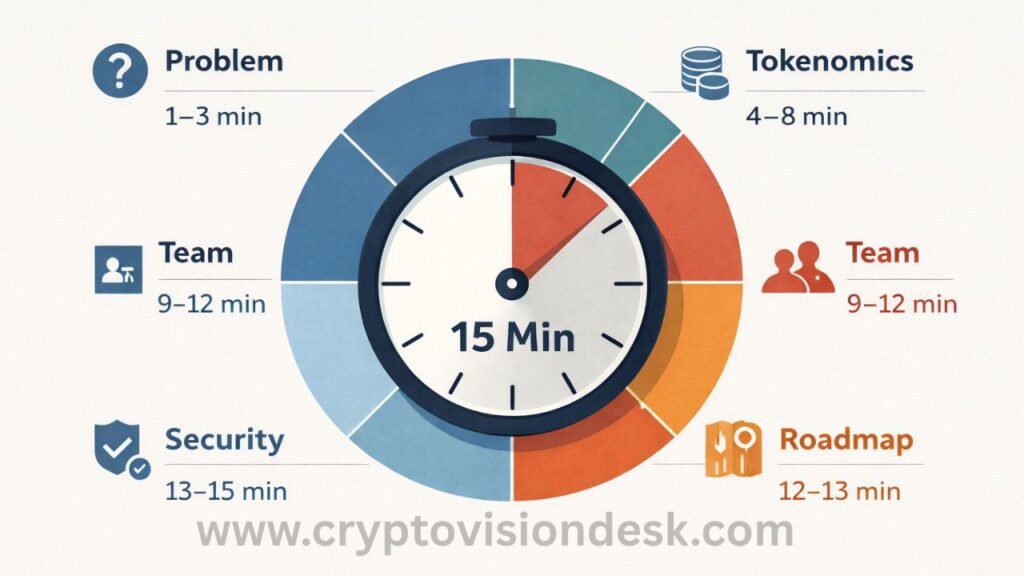
Speed comes from reading in the right order. Start with clarity, then money flow, then people and execution. If a section is missing, treat that as a risk signal. Don’t fill gaps with your imagination.
Use this scan once, take notes, and keep moving. If you spot two or more major red flags, stop there and don’t buy. You can always come back later if the project cleans things up.
| Time | Where to look | What you’re trying to learn | Major red flags |
|---|---|---|---|
| 1 to 3 minutes | Problem and solution | Can you explain it in one sentence? | Vague mission, heavy jargon, no real user |
| 4 to 8 minutes | Tokenomics | Who gets tokens, when they unlock, what the token actually does | Missing supply, insiders dominate, no vesting, “price up” language |
| 9 to 12 minutes | Team, roadmap, security | Can these people build it, and do they treat security seriously? | Unverifiable team, “soon” roadmap, no audit plan |
| 12 to 15 minutes | Risks and links | Do they admit risks, and do references check out? | No risks section, broken links, copied text |
Minute 1 to 3: Can you explain the problem and solution in one sentence?
Start at the top and ignore the buzzwords. You’re hunting for a plain answer to three things: what problem they solve, who feels that pain, and why a blockchain is needed.
A good whitepaper makes this easy. A weak one tries to impress you instead of informing you. If you read two pages and still can’t explain it, that’s not you being “new.” That’s the paper failing its job.
Here’s a simple test: try to explain the project to a friend using normal words. If you end up saying, “It’s like AI plus DeFi plus Web3,” you don’t understand it yet, and the paper probably isn’t clear.
In 2026, the most common “fake clarity” pattern is claiming they’ll replace major networks quickly (or be faster, cheaper, and more decentralized than everyone) with no tradeoffs. Real systems have tradeoffs, and honest teams admit them. Also watch for missions like “build the future of finance” with no specific user and no specific action.
If the project can’t say who the user is (traders, game studios, merchants, hospitals), assume they’re building for hype, not demand.
Minute 4 to 8: Skim tokenomics like a detective (supply, distribution, utility)
Tokenomics is where many beginner losses begin, because it’s where dumping pressure comes from. Read this part like you’re reading a contract, not a story.
First, find total supply. If it’s unlimited or unclear, you have a problem. An inflationary token can work, but only if emissions are explained in a way you can track. “We’ll adjust later” is not a plan.
Next, find distribution percentages. Who gets what, team, investors, community rewards, treasury, partners? You’re not looking for “fairness vibes.” You’re looking for whether insiders can control price.
Then look for vesting and lockups. If early holders unlock quickly, they can sell into hype. In late 2025 and early 2026, many rug pulls and memecoin scams followed a familiar pattern: heavy insider control, fast unlocks, then liquidity gets pulled or the chart collapses. The Kokomo Finance rug pull is one example that showed how quickly a project can turn when trust and controls are weak, including code changes that harmed users.
Finally, ask what the token actually does. “Governance” alone usually isn’t enough. A token needs a real job, paying fees, providing collateral, securing the network, or granting access to a service people already want. If the utility is vague, or the paper hints at “guaranteed growth,” treat it as marketing, not design.
Quick gut check: can you describe the token’s job in one line that doesn’t mention price?
Minute 9 to 12: Verify the team and roadmap, then look for basic security talk
A whitepaper can be pretty and still be meaningless if the builders aren’t real, or if the plan is fluff.
For the team, look for real names and roles, plus profiles you can verify. One strong engineer with a history of shipping beats a page of anonymous avatars. An anonymous team isn’t always a scam (privacy can be a real concern), but anonymity raises the bar. If they’re anonymous, the paper should compensate with strong proofs, like open-source code, reputable audits, and clear on-chain controls.
For the roadmap, you want measurable milestones. “Q2: expand ecosystem” is not measurable. “Q2: ship testnet, publish audit report, open bug bounty” is measurable. Also check whether they show progress updates. A roadmap that never mentions what’s already done is often a sign they’re selling a future that doesn’t exist.
Then scan for security basics. A serious project talks about audits, how admin keys are handled, upgrade risks, and what happens if something breaks. Many losses in DeFi come from simple failures: unsafe upgrades, poor key management, rushed launches, or weak monitoring. If the whitepaper acts like hacks are impossible, that’s a red flag by itself.
Beginner red-flag checklist that catches most scams
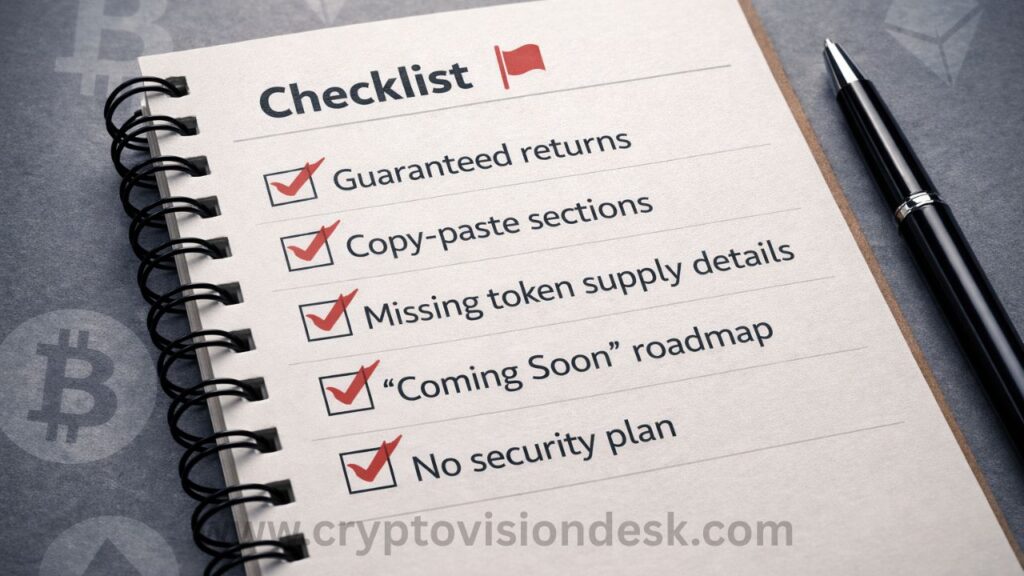
Copy this section into your notes and use it every time. One red flag is a warning. Multiple red flags is a no.
- Writing and credibility: Lots of typos, copied-looking sections, broken links, missing definitions, heavy buzzwords, no citations or references, no clear risks section, “guaranteed returns,” pressure language like “limited time” or “don’t miss out.”
- Tokenomics and money flow: Missing total supply, unclear emissions, no vesting or lockups, insiders or “partners” get a huge share with no names, vague treasury control, unclear use of funds, confusing fees, rewards that only work if new buyers keep arriving.
- Tech and roadmap: Magical claims with no tradeoffs, no security plan, no testing or audit mentions, unrealistic timelines, constant moving targets, “we will integrate everything” with no steps, no explanation of failure cases.
Writing and credibility red flags (the stuff scammers get lazy about)
Sloppy writing isn’t just an English issue. It often matches sloppy execution.
Watch for missing definitions. If they use words like “validator,” “sequencer,” “restaking,” “L2,” or “RWA” but never define how they use them, you can’t evaluate anything. A real whitepaper teaches you its terms.
Also watch for fake authority. Some papers throw in academic-style formatting, then cite nothing. Others “name drop” big chains or famous companies without showing partnerships. If the whitepaper claims backing, it should link to something verifiable, not just a logo.
The biggest credibility red flag is refusing to talk about risk. Honest teams say what can go wrong: smart contract risk, oracle risk, governance capture, regulatory risk, liquidity risk, and simple user error. If the paper reads like a perfect fairy tale, it’s likely written to sell, not to inform.
Another common pattern in 2025 to 2026 scam waves is urgency. Pressure language is there to stop you from thinking. Real builders want long-term users, not rushed buyers.
Tokenomics and money-flow red flags (where rug pulls usually hide)
Ask one blunt question: who can dump on you, and when?
If the answer is “the team,” “early investors,” or “unknown partner wallets,” treat the token as a hot potato. Many beginner losses don’t come from hacks. They come from unlocks and selling pressure that was always in the plan, just hidden in fine print.
Be cautious when allocations are vague, like “strategic partners” or “ecosystem.” If they can’t name who gets tokens, you can’t judge incentives. Be cautious when the treasury is described like a piggy bank with no controls. Who holds the keys, is there multi-signature, is there on-chain governance, can upgrades move funds?
Also be cautious with reward systems that look like free money. If the whitepaper implies rewards come from “community growth” but doesn’t explain real revenue, you might be looking at a loop where new buyers pay old buyers. That structure breaks the moment hype slows.
In late 2025 and early 2026, memecoin rug pulls often added extra traps, like sell restrictions, hidden taxes, or liquidity that wasn’t truly locked. A whitepaper might not spell that out, which is why tokenomics vagueness is itself a warning.
Tech and roadmap red flags (big promises, tiny proof)
You don’t need to understand every formula. You do need to understand the basic idea and its risks.
If a project claims it solved the blockchain trilemma, eliminated MEV, guaranteed privacy, and scaled to massive throughput, it should explain how and what it gives up. Systems don’t get everything at once.
Watch for papers that never talk about constraints. Costs, latency, data availability, governance attacks, validator incentives, and upgrade risk are not optional topics. If the whitepaper only lists benefits, it’s marketing.
Roadmap red flags often sound innocent: “launch soon,” “partnerships coming,” “marketing push,” “global expansion.” Those are not product milestones. You want evidence of work, testnet results, code commits, audits scheduled, and a timeline that respects reality.
A beginner-friendly rule: if the roadmap depends on “integrating everything,” but doesn’t show the first small step, it’s likely fantasy.
A simple scorecard you can use before you buy anything
A checklist helps, but a scorecard helps you decide. This one is designed for beginners who want a fast, repeatable method.
Open your notes app, paste the questions, and answer Yes or No based only on what you can verify from the whitepaper and its links. A good score doesn’t mean guaranteed success. It just lowers the chance you missed an obvious trap.
The 12-question yes or no scorecard (copy, paste, and fill in)
Score each as Yes (1) or No or unclear (0):
- Is the problem clear in one sentence?
- Is the target user clear (who will use it)?
- Do they explain why a blockchain is needed?
- Does the token have real utility beyond vague governance?
- Is total supply stated clearly?
- Are distribution percentages stated clearly?
- Are vesting and lockups stated clearly?
- Is the insider share reasonable (not dominating supply)?
- Is the roadmap measurable (real deliverables, not slogans)?
- Is the team verifiable (real identities or strong proof)?
- Is there a security plan (audits, key control, upgrade risk)?
- Do they disclose risks in plain language?
Scoring guide: 10 to 12 points = research more, 7 to 9 = wait, 0 to 6 = skip.
What to do when something is unclear (the safe next step)
Unclear doesn’t mean scam, it means risk. Your safest move is to slow down and verify.
| If you can’t verify… | Check next | What a good answer looks like |
|---|---|---|
| Token supply, unlocks, or allocations | Token docs, explorer links, vesting schedules | Exact numbers, dates, wallets, or on-chain contracts |
| Team claims | LinkedIn, past projects, interviews, conference talks | Consistent history, real work, real peers |
| Security claims | Audit reports, bug bounty details, repo activity | Named auditors, clear scope, fixes published |
| Roadmap progress | GitHub, testnet announcements, changelogs | Dated updates, shipped milestones, measurable results |
If the official channels dodge basic questions, or replies turn into insults and hype, walk away. If you’re still unsure, sticking with established coins and smaller position sizes is a valid choice. You don’t get a prize for being early.
Frequently Asked Questions About Reading a Crypto Whitepaper Fast (2026)
How long should it take to read a crypto whitepaper as a beginner?
About 10 to 15 minutes for a first pass. The goal is not deep research, it is to decide whether to investigate more or walk away based on clarity, tokenomics, the team, the roadmap, and basic security signals.
What are the biggest red flags in a crypto whitepaper?
The most common red flags are a vague problem statement, heavy jargon with no clear user, missing token supply or allocations, no vesting and lockups, an unverifiable (or fully anonymous) team with no proof, a “soon” roadmap with no deliverables, no audit plan, no risks section, and any hint of guaranteed returns or pressure language.
What should I check first in a whitepaper if I only have a few minutes?
Start with the problem and solution. You should be able to explain what it does, who it is for, and why it needs a blockchain in one sentence. If that fails, the rest is usually not worth your time.
What tokenomics details matter most before buying a token?
Total supply, distribution percentages (team, investors, community, treasury), and vesting and lockup timelines matter most. Then confirm what the token actually does (fees, collateral, security, access), because “governance” alone is often weak utility.
What does a “real” security section look like in a whitepaper?
It mentions audits (or planned audits) with clear scope, how admin keys are controlled (for example multi-signature), upgrade risks, and what happens if something breaks. If the paper acts like hacks are impossible, treat that as a red flag.
Conclusion

Reading a crypto whitepaper fast is a skill, not a talent. Scan in order: clarity first, tokenomics next, then team, roadmap, and security. The biggest red flags stay the same in 2026, a vague problem, an anonymous or unverifiable team, unfair tokenomics, unrealistic timelines, no security plan, and any hint of guaranteed returns.
Use the scorecard every time, and treat rushed decisions as a trap. There will always be another project. You can’t always get your money back, so protect it with a repeatable checklist and the patience to say no.
Read Also: Crypto Predictions 2026-2027: Beginner Guide
Disclaimer
The information provided on this website is published in good faith and for general informational and educational purposes only. It does not constitute financial, investment, trading, legal, or tax advice of any kind.
Cryptocurrencies and digital assets are highly volatile and involve substantial risk. Market conditions can change rapidly, and users may lose some or all of their invested capital. Any actions taken based on the information found on this website are strictly at the reader’s own risk.
References to cryptocurrencies, exchanges, wallets, tools, platforms, or strategies are shared solely for educational awareness and should not be interpreted as recommendations, endorsements, or professional advice.
Readers are advised to conduct their own research (DYOR) and seek guidance from a qualified financial advisor, tax consultant, or legal professional before making any financial or investment decisions.
Cryptocurrency laws, regulations, and taxation policies—particularly in India—may change over time. The content on this website is based on publicly available information at the time of publication and may not reflect the most recent legal or regulatory updates.
The website owner, authors, and contributors do not accept any liability for losses, damages, or consequences arising from the use of the information provided on this website.
Some content on this website may contain affiliate links. This means we may earn a small commission at no additional cost to you. This does not influence the accuracy, transparency, or integrity of the content.