
How Much Should A Beginner Invest In Crypto In 2026 (Smart Rule That Works)

You want the upside of crypto, but you hate the idea of losing your savings. That mix of curiosity and fear is normal.
Crypto has made some people rich. Bitcoin hit around $126,000 in 2025, then dropped over 25% in a short time. Big moves up, big drops down. That is how this market works.
This guide gives you a clear answer to how much a beginner should invest in crypto, with a simple rule of thumb, real dollar examples, and steps that fit 2026. No hype, just numbers and common sense.
Should You Even Invest In Crypto As A Beginner In 2026?
Before you think about how much, you need to decide if you should invest at all.
Crypto is digital money and digital assets on blockchains. People use it today for payments, saving, sending money across borders, and new apps like DeFi and NFTs. In 2026, more banks, funds, and ETFs are involved. Some experts think Bitcoin could reach six figures again. Others see Ethereum growing as more apps and ETFs build on it.
None of that is guaranteed.
Prices still swing hard. Bitcoin is around the $90,000 to $94,000 range after big highs. Ethereum moves between roughly $2,800 and $3,450. Predictions for 2026 talk about Bitcoin anywhere from around $94,000 to $150,000 and Ethereum anywhere from around $3,700 to $11,000. That wide range shows how unsure things are.
So crypto should be a small, risky piece of your full money plan, not the main plan. Think of it as the “spicy” part on the side of your plate, not the main meal.
Why People Want Crypto In 2026 (But Need To Be Careful)
People still rush into crypto in 2026 for a few clear reasons:
- Big growth stories: Bitcoin has gone from under $1,000 to tens of thousands. Even after drops, long‑term charts look strong. That pulls people in.
- New tech: Ethereum powers smart contracts, DeFi, NFTs, and more. Many see it as a core building block for future apps.
- ETFs and banks: Spot Bitcoin ETFs brought billions of dollars from regular investors and big funds. Some banks now offer Bitcoin research or access to crypto products.
- Adoption by companies and countries: More firms hold some Bitcoin in their treasury. Some countries work on friendlier rules. This feels like progress to many investors.
- Success stories: The friend who “turned $500 into $20,000,” the early buyer who retired, the influencer who shows unreal gains.
The other side is much less fun:
- Bitcoin can drop 50% or more from a peak.
- Ethereum can lose half its value in a year.
- New rules or tax changes can hit prices.
- Coins can fail, projects can close, hype can vanish in a month.
Both sides are real. You need to see the full picture, not just the win stories.
Big Risks Beginner Crypto Investors Often Ignore
Here are the main risks beginners skip or downplay:
- Wild price swings: A coin can move up or down 10% in a day, sometimes more.
- Scams and hacks: Fake apps, “giveaway” scams, rug pulls, and hacked projects are common. Reports over the last few years show tens of billions of dollars lost this way.
- Exchange failures: Big names can fail. FTX looked safe to many people, then collapsed and locked user funds.
- Tech bugs: Smart contracts can have bugs. If code breaks, you may not get your money back.
- No government safety net: There is no FDIC insurance for your tokens. If an exchange fails or your wallet gets drained, there may be no refund.
- Social media hype: Influencers get paid to push coins. Group chats can pressure you to “ape in” fast.
Repeat this to yourself before you buy even $1 of crypto: I must be ready to lose every dollar I put into crypto. If that thought makes you sick, your amount is too high.
Smart Rule For How Much A Beginner Should Invest In Crypto In 2026
Now to the heart of it. You want one clear rule.
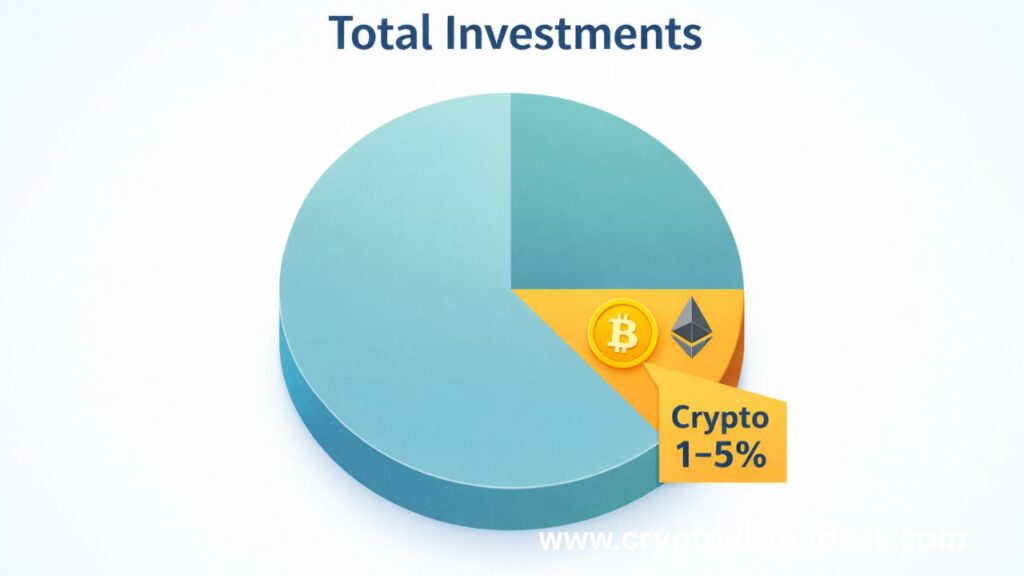
Here it is: for beginners, keep crypto at about 1–5% of your total investments.
That is it. Simple, but powerful when you stick to it.
The Simple Rule: Start With 1–5% Of Your Total Investments
“Total investments” means all your money that is set aside for saving and investing. That usually includes:
- Cash savings you will not need for at least a year
- Retirement accounts, like a 401(k) or IRA
- Stock and bond funds
- Other long‑term investments
Crypto then sits as a small slice of that whole pie.
- Around 1% is very careful.
- Around 3% is moderate.
- Around 5% is aggressive for a beginner.
More than 5% is usually too much risk at the start, even if you feel brave. Your feelings change fast when your coin drops 40%.
So you can repeat this: “I will keep my beginner crypto at 1–5% of my total investments.”
Real Dollar Examples: How Much Crypto To Buy Based On Your Situation
Let’s turn that 1–5% rule into real numbers you can picture.
Assume this is your total investment pot, not just “extra money this month.”
| Total investments | 1% (very careful) | 3% (moderate) | 5% (aggressive for beginners) |
|---|---|---|---|
| $1,000 | $10 | $30 | $50 |
| $5,000 | $50 | $150 | $250 |
| $10,000 | $100 | $300 | $500 |
| $50,000 | $500 | $1,500 | $2,500 |
How might this look in real life?
- If you have $1,000 invested in total and you are very nervous, $10 in crypto is fine. That is not a typo.
- If you have $5,000 and feel okay with some risk, $150 is a fair middle ground.
- If you have $10,000 and a strong stomach for swings, $500 might work, as long as you accept big ups and downs.
- Someone with $50,000 and good savings might decide $1,500 is enough for a moderate approach.
Picture your own total number, then pick a slice from 1–5% that fits your risk comfort.
Why You Should Start Tiny First ($50–$200 Test Amount)
Before you even reach your full 1–5% target, start smaller. Think of a $50–$200 test amount as a “tuition fee” for crypto.
You pay this small amount to learn:
- How to open an exchange account
- How to buy and sell
- How to send coins to a wallet
- How prices move day to day
You are not trying to win big with this first money. You are just learning the tools.
You can buy tiny pieces of Bitcoin or Ethereum. You do not need a whole coin. You can buy $50 of Bitcoin the same way you buy $50 of a stock.
After a few months of learning with this test money, you can slowly move toward your 1–5% target if you still feel okay.
Check These 3 Things Before You Put Any Money In
Before you spend a single dollar on crypto, walk through this quick checklist.
- You have an emergency fund.
Aim for at least 3–6 months of basic living costs in cash or a savings account. This is your real safety net. Crypto is not. - Your debt plan is under control.
You pay at least the minimums on all debts. You focus on paying down high‑interest cards and loans first. If your credit card charges 20% interest, that is a fire you should put out before you buy coins. - You accept that crypto could go to zero.
If your coin crashed to nothing, life would still be okay. Bills would still be paid. No one in your house would miss rent money.
If you cannot check all three boxes yet, pause. Fix those basics first, then come back to crypto later.
How To Spread Your Beginner Crypto Investment Safely In 2026

Once you know your number, the next step is how to use it in a safer way.
You want to pick stronger coins, spread your buys over time, and protect your accounts from scams.
Which Coins Should Beginners Buy First (And Which To Avoid)
Most beginners should start with the largest and most tested coins.
A simple starting point:
- Bitcoin (BTC): often treated like “digital gold”
- Ethereum (ETH): often treated as the main smart contract platform
These two have:
- Long track records compared to most coins
- Large trading volume
- Wider use by banks, funds, and ETFs
A simple beginner split could be:
- 60% in BTC
- 40% in ETH
If your total crypto target is $300, that might mean $180 in BTC and $120 in ETH.
Coins to treat with extra care:
- New meme coins with no clear use
- Tiny projects with no history or small teams
- Anything that only exists in Telegram groups and hype videos
- Coins that promise “guaranteed” returns or “risk‑free” yield
If an influencer screams that a coin will “100x soon,” that is a red flag, not a green light.
Use Dollar Cost Averaging Instead Of One Big Bet
Dollar cost averaging sounds complex, but it is simple.
You buy the same small amount on a regular schedule, no matter what the price is.
Example:
- Instead of dropping $600 into crypto today
- You buy $50 each month for 12 months
Some months you buy when prices are high. Some months when they are low. Over time, you get an average price.
This helps you:
- Avoid buying your full amount at the peak
- Build a habit that does not depend on perfect timing
- Stay calm, since you know when and how much you will buy
You can use dollar cost averaging to reach your 1–5% target slowly, not in one jump.
Basic Safety: Exchanges, Wallets, And Not Getting Hacked
Treat crypto like cash that thieves want to steal.
Simple safety steps:
- Pick a trusted, regulated exchange or app.
Use big, known names in your country. Check reviews and security features. - Turn on two‑factor authentication (2FA).
Use an app like Google Authenticator or Authy. Do not rely only on text messages. - Use strong, unique passwords.
A password manager helps a lot. Never reuse the same password from your email or social media. - Guard your seed phrase.
When you create a wallet, you get 12 or 24 words. Write them on paper, store them offline, and never share them. - Know this rule: if anyone asks for your private keys or seed phrase, it is a scam.
If your crypto grows to a larger amount in the future, you can look into a hardware wallet. For a small beginner amount, strong exchange security and good habits go a long way.
How To Keep Your Crypto Plan On Track Without Losing Sleep
The 1–5% rule is not just about risk. It is also about peace of mind.
If crypto is only a thin slice of your money, price drops will sting, but they will not ruin your life. You can sleep at night and stay focused on long‑term goals.
Set Clear Goals And Timeframes For Your Crypto Money
Decide what role crypto plays in your life.
Is it:
- Learning money to understand new tech?
- Long‑term growth money that you plan to hold for years?
- Fun money to try a few apps and tokens?
Pick one main goal. Then pick a time frame of at least 3–5 years. Not 3–5 days.
Clear goals help you:
- Hold through normal drops without panic
- Ignore random hype that does not fit your plan
- Avoid turning long‑term money into a short‑term gamble
Write your goal and time frame down somewhere you see often.
When To Add More, Hold Steady, Or Take Profits
As your overall investments grow, your crypto slice will change too.
A simple way to manage it:
- Once or twice a year, look at all your investments.
- Check what percent is in crypto.
- If crypto is below your target (like 1–3%), and your money life is strong, you can add a bit.
- If you lost money and feel angry or scared, do not add more yet. Wait until you feel calm and clear.
A basic profit rule:
- If crypto grows to more than 5–7% of your total investments, take some gains.
- Sell enough to bring it back near your target range.
- Move the extra money to cash or stock funds.
This way, your risk does not silently grow too large just because prices went up.
Red Flags That You Are Investing Too Much In Crypto
Watch for these warning signs:
- You use rent or bill money to buy coins.
- You borrow from a friend, family member, or loan app to invest.
- You cannot sleep when prices drop.
- You check prices every few minutes.
- You keep jumping from coin to coin based on social media.
- You feel a strong need to “win it all back” after a loss.
If you see yourself in this list, cut back. Move your crypto down to the 1–3% range. Take a break and focus on learning, not trading.
Read Also: Bitcoin vs Ethereum in : Simple Beginner’s Guide to Choosing Your First Crypto
Conclusion
Crypto in 2026 still offers big upside, but risk is just as big. That is why beginners should treat it as a small slice of their money, not the whole plan.
A simple rule works well: keep crypto around 1–5% of your total investments, and often start with just $50–$200 as a learning amount. Build slowly, use mainly Bitcoin and Ethereum at first, and buy on a steady schedule instead of one big bet.
When you follow this rule, you protect yourself from huge losses while still leaving room for growth and learning. Know your numbers, pick a tiny starting amount, use dollar cost averaging, and stay focused on long‑term learning instead of quick wins.
Your future self will thank you for treating crypto like a smart side dish, not the whole meal.
“Disclaimer: This article is for educational purposes only and should not be considered tax or legal advice. Please consult a qualified tax professional.”
Read Also: Best Low Risk Altcoins 2026 Guide for New Investors