
Best Layer 2 Coins to Watch in 2026 (Full Guide)
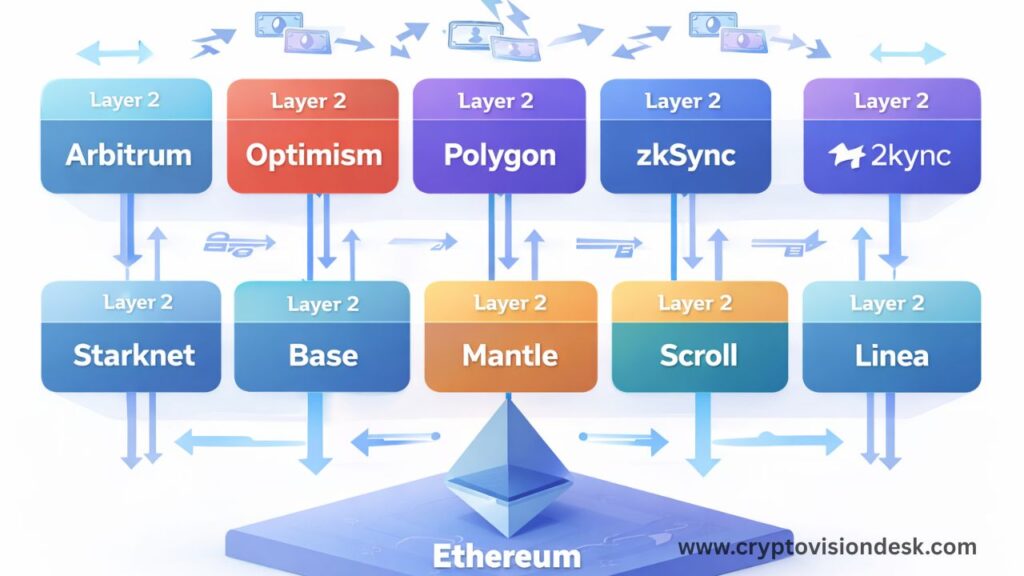
If you care about crypto in the next few years, you should care about Layer 2 coins. A Layer 2 is a network that sits on top of Ethereum or another base chain, helps it handle more transactions, and makes those transactions faster and cheaper. Instead of every trade or swap fighting for space on Ethereum itself, L2s batch them up, settle back to Ethereum, and pass the savings on to users.
In 2024 and 2025, Layer 2 use exploded as fees dropped to just a few cents and more apps moved off mainnet. Many experts think 2026 could be a breakout year for L2s if the crypto market stays strong, as more value, users, and games shift to these cheaper chains.
This guide walks through key L2 coins and networks to watch, like Arbitrum, Optimism, Polygon, zkSync, Base, Starknet, Mantle, Linea, and Scroll. It is not financial advice, just research to help regular investors and crypto fans see which projects are gaining traction so they can follow the trends and do their own homework before putting money at risk.
What Are Layer 2 Coins and Why Do They Matter for 2026?
Layer 2 networks are quickly becoming the main place where everyday crypto activity happens. Swaps, games, NFT trades, and payments are moving off Ethereum mainnet and onto cheaper, faster L2s. The coins tied to these L2s sit at the center of that shift, because they help run the networks and capture some of the value that flows through them.
If 2024 and 2025 were the rollout years, 2026 is shaping up to be the stress test. By then, we will see which Layer 2s keep real users, strong apps, and healthy token economies, and which ones fade into the background.
Simple explanation of Layer 2s and rollups
A simple way to picture Layer 2 is to think about a busy highway.
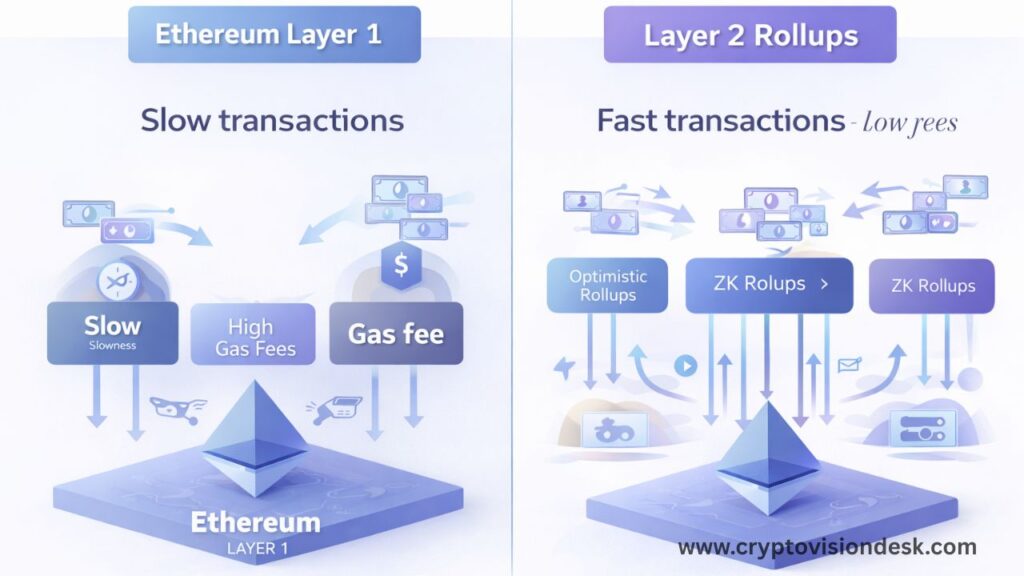
- Layer 1 (Ethereum) is the main highway. It is strong, secure, and everyone trusts it, but it gets jammed in rush hour and tolls get expensive.
- Layer 2 networks are like extra express lanes and side roads that run alongside that highway. Most cars use the side roads for faster, cheaper travel, but the side roads still connect back to the main highway at certain points.
In crypto terms, a Layer 2 sits on top of Ethereum. It processes many transactions off the main chain, then sends a compressed summary back to Ethereum. That way, you still get Ethereum-level security, but with lower fees and higher speeds.
Layer 2 tokens usually have a few key roles:
- Governance: voting on upgrades, fee changes, and ecosystem grants.
- Paying some fees: gas or priority fees on the L2 itself.
- Incentives: rewarding validators, sequencers, or stakers who help keep the network running.
- Growth capital: funding builders, liquidity programs, and user rewards.
Most popular L2s today use a type of tech called a rollup, which batches many transactions into one package.
There are two main flavors:
- Optimistic rollups: They post transaction data back to Ethereum and assume it is valid unless someone proves fraud within a short window. This keeps things simple and cheap, but withdrawals to Ethereum can take longer because of that waiting period.
- ZK rollups (zero-knowledge rollups): They also post data back to Ethereum, but they attach a cryptographic proof that shows the batch is valid. Ethereum checks the proof, accepts the batch, and finality can be much faster, at the cost of more complex tech.
You do not need to understand the math to follow the investments. What matters is that rollups let Ethereum handle far more activity without breaking fees, and L2 tokens are your way to get exposure to those growing ecosystems.
How Layer 2 tokens can gain or lose value
L2 tokens are not just numbers on a screen. They sit at the center of networks that either attract real use or slowly dry up. Several core drivers can push these tokens up or down.
Here is what tends to add value over time:
- More users and apps
When more people trade, bridge, play games, or mint NFTs on an L2, demand for block space on that chain rises. Strong DeFi platforms, active NFT markets, and sticky games usually mean deeper liquidity and more reasons to hold or use the token. - Higher fee volume on the network
Every transaction generates fees. On many L2s, part of those fees:- gets burned or removed from supply, or
- flows to sequencers, validators, or stakers.
If an L2 routes billions in DeFi and gaming volume, fees stack up. That can support higher valuations, especially if the token soaks up some of that value.
- Good token design and utility
Design matters more than hype. Strong setups often include:- Staking or locking to secure the network or share in sequencer revenue.
- Governance power that holders actually use to steer upgrades and treasury spending.
- Direct demand to pay gas or priority fees on the L2.
Tokens that tie clearly to usage and cash flow usually age better than pure “governance only” coins.
- Security, brand, and trust
Users care about safety and familiarity. Well-reviewed code, battle-tested bridges, audits, and a strong brand (like “the default chain for DeFi” or “the home of top games”) can all pull in sticky capital. Institutions and bigger apps tend to prefer L2s that look serious on the security and compliance front. - Clear, credible roadmap
Teams that ship upgrades on time, improve UX, add features like better bridges or privacy, and support developers often create a flywheel. More builders show up, more users follow, and the token becomes central to that growth story.
On the flip side, several factors can hurt value:
- Bugs, exploits, or bridge hacks
A single exploit can drain liquidity, kill user trust, and crush a token. L2s that rush upgrades or skip security reviews take on real risk. - Low real usage
If daily active users and transaction counts stay low, even a hyped L2 can start to look like a ghost town. Without steady fees or app demand, token value rests almost entirely on speculation. - Aggressive token unlocks and poor supply schedules
When large chunks of tokens unlock for early investors or the team, heavy selling can cap price for months. If emissions are too high, or rewards are not tied to long-term behavior, inflation can overwhelm demand. - Unclear direction or weak community
Roadmaps that change every quarter, leadership churn, or poor communication can all drain confidence. When builders and users move to other L2s, token value often follows.
All of this connects directly to why 2026 looks like a key test year. By then:
- Many L2s will have:
- full DeFi stacks,
- live gaming ecosystems, and
- active NFT markets.
- Rollup tooling and developer kits will be mature, so building on L2 will be far easier.
- Large unlocks for several L2 tokens will be behind us or in progress, so supply pressure and real demand will be much clearer.
In simple terms, 2026 is when the training wheels come off. The L2 tokens that combine strong usage, solid token design, and good risk management could separate from the rest, while weaker chains with low activity or bad token economics may fade or turn into “zombie” networks that trade on inertia only.
Key Trends Shaping the Best Layer 2 Coins in 2026
Before picking specific Layer 2 coins, it helps to zoom out and look at the big forces moving the whole sector. L2 adoption is not random. It follows clear trends in how users move, how apps choose where to deploy, and how liquidity shuffles across chains.
If you care about Layer 2 trends for 2026, these are the shifts that matter most.
Shift from single chains to an “L2 world”
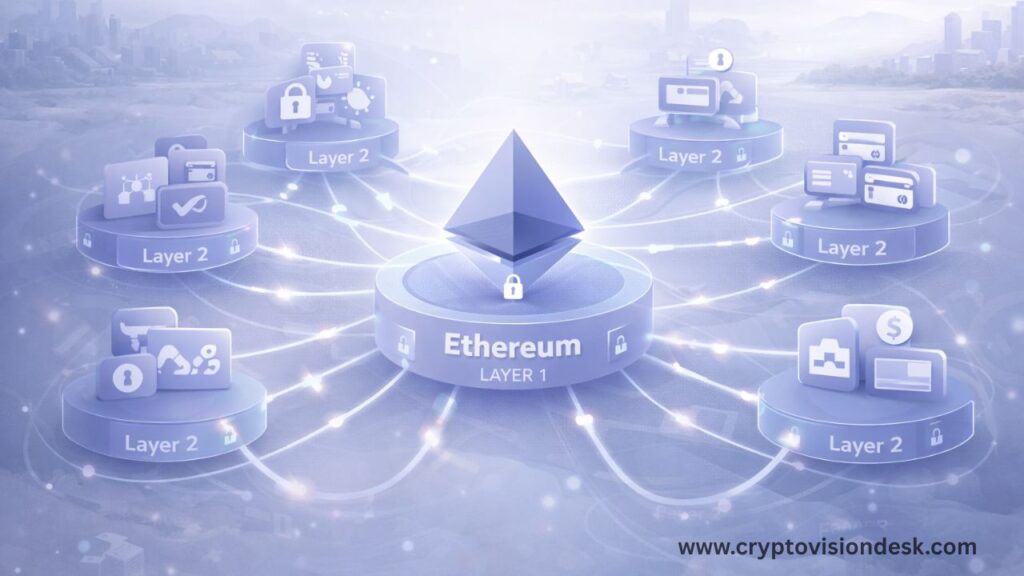
Ethereum is turning into a hub with many spokes, not a single road where everything happens in one place. Instead of every app, NFT, and game living on mainnet, activity is spreading across a web of L2 networks that all settle back to Ethereum.
In practice, that means:
- Arbitrum, Optimism, Base, zkSync, Starknet, Scroll, Linea, and others all share Ethereum as a base.
- Each L2 handles its own users and transactions, then posts data and security proofs to Ethereum.
- Ethereum becomes the settlement and security layer, while day‑to‑day usage lives on L2s.
So instead of one crowded city, you now have a cluster of suburbs around a strong downtown. The suburbs handle most of the traffic. The downtown (Ethereum) stays safe, expensive, and slow by design, while the suburbs (L2s) stay cheap and fast.
That shift fixes a big part of the scale problem, but it creates a new one: fragmented liquidity.
Liquidity is no longer piled in one place. You may have:
- Deep DeFi pools on Arbitrum.
- Active NFT trading on Base.
- Early airdrop farmers on zkSync or Starknet.
- Niche DeFi or gaming on smaller L2s.
When capital, users, and apps split across many chains, simple things get harder:
- Swapping tokens across L2s means more bridges and more steps.
- Pricing can drift, since the same asset trades in many pools on many chains.
- Yield hunters and arbitrage traders have to hop around more to chase returns.
Because of this, L2 connector tools are becoming just as important as the L2s themselves. You will see more:
- Cross‑chain DEXs and aggregators that route your trade across several rollups to find the best price.
- Unified wallets that let you see and move funds across many L2s without switching networks all the time.
- Shared liquidity layers that let protocols pull from one common pool, even if users sit on different L2s.
For investors watching L2 adoption forecasts for 2026, the key question is not only which chain wins, but which chains plug in best to this L2 world. The L2s that feel connected, easy to move in and out of, and friendly to cross‑chain tools have a clear edge.
Optimistic rollups vs zk rollups in late 2025
As of late 2025, optimistic rollups still hold the lead in real usage, even though zk rollups often get more hype on the tech side.
Based on the latest industry data:
- Arbitrum is the largest L2 by TVL and users, with multi‑billion TVL and hundreds of thousands of daily users.
- Optimism sits behind Arbitrum but still holds billions in TVL and a deep app stack.
- zkSync Era and Starknet are the most active zk rollups, although they hold less TVL and fewer users than Arbitrum and Optimism.
- Scroll and Linea are smaller in both TVL and user counts, but are still part of the zk rollup story and get attention from builders.
A quick side‑by‑side view helps:
| L2 category | Examples | Status in late 2025 |
|---|---|---|
| Optimistic rollups | Arbitrum, Optimism | Higher TVL, more users, strong DeFi ecosystems |
| zk rollups | zkSync, Starknet, Scroll, Linea | Lower TVL today, stronger long‑term tech narrative |
Optimistic rollups win on today’s adoption because:
- They were early, so most DeFi teams and liquidity moved there first.
- They are highly EVM‑compatible, so apps could copy and paste code with little change.
- They built rich yield and trading markets that keep capital parked there.
zk rollups, on the other hand, have the stronger long‑term tech story:
- They use validity proofs, which give strong finality and good security properties.
- They promise faster withdrawal and more flexible use cases in the future.
- They often target advanced features like privacy, better compression, or new programming models.
For now, that tech edge is held back by higher costs and weaker tooling. Proving transactions is still expensive, infrastructure is more complex, and developer tools are not as smooth as on the optimistic side.
This gap is exactly what investors watch as they look at zk rollup growth into 2026:
- If zk proof costs drop, fees on zk L2s can challenge or beat optimistic rollups.
- If tooling improves, developers can ship apps on zk chains as easily as they do on Arbitrum or Optimism.
- If user flows improve (better bridges, simple wallets), the UX difference can disappear.
If those pieces come together by 2026, some zk rollups could grab a bigger share of users and TVL. Until then, optimistic rollups keep most of the current economic weight, while zk rollups trade more on expectations and future potential.
Why user experience and security will decide L2 winners
Every Layer 2 talks about scale, but users care about simple things: cost, speed, safety, and ease of use. In 2026, those basics will do more to pick winners than any clever whitepaper.
Here is what people actually feel when they use an L2:
- Cheap and fast transactions
If a swap costs a few cents and confirms in seconds, users stick around. If fees spike or transactions hang, they leave. L2s compete hard on average fee, but also on how stable those fees stay when things get busy. - Easy wallets and bridges
Most people do not want to juggle many RPCs, custom tokens, and obscure bridges. The L2s that win will:- plug into popular wallets by default,
- offer one‑click bridging from mainnet,
- and give clear messages when funds move between chains.
Good UX turns a complex rollup into something that feels like using a normal app.
- Strong fiat on‑ramps
On‑ramps matter because they remove friction at the first step. Base, for example, benefits from the Coinbase link, since users can move from fiat to Base with only a few taps. If an L2 has direct listings on major exchanges or built‑in on‑ramp partners, new users can land there without touching mainnet first. - Clean security record
Users and serious capital care about what has already happened:- Has the L2 had any bridge hacks or major outages?
- Are upgrades controlled by a multisig, or has the team moved toward decentralized security?
- Are contracts audited and monitored?
A long, quiet track record with no major incidents becomes a real asset as more value moves on chain.
A big pattern in 2024 and 2025 is that many new L2s grow fast at launch. They push airdrops, rewards, and marketing, and numbers spike. What still needs to be proven is:
- Can they keep users once rewards slow down?
- Can they pay sequencer costs and stay profitable with fair fees?
- Can they avoid serious security events for several years in a row?
This is why fee models and safety will be key filters for L2 coins in 2026. Some networks can offer very low fees for a while by burning runway or subsidies. That is fine for bootstrapping, but investors look for:
- Sustainable fee levels that still cover costs.
- Clear revenue sharing or value capture that flows back to the token.
- Real usage that keeps fees flowing even without heavy incentives.
Put simply, the Layer 2 coins that deserve attention in 2026 will sit on chains that feel cheap, fast, safe, and simple to use. Tech type matters, but user experience and security history will do most of the work in sorting long‑term winners from short‑term hype.
Top Established Layer 2 Coins to Watch in 2026
If you prefer higher conviction bets over experimental chains, the most established Layer 2 coins are a natural place to start. These networks already hold large amounts of capital, host deep DeFi stacks, and have active developer communities. That does not remove risk, but it does give you more history to study before you decide what to do with your money.
Let’s look at three of the biggest Layer 2 ecosystems and why many traders plan to track them closely going into 2026.
Arbitrum (ARB): Largest DeFi and gaming hub on Layer 2
Arbitrum is one of the largest Ethereum Layer 2 networks by total value locked (TVL) and by the number of live apps. It uses an optimistic rollup design, so it batches transactions off-chain, then posts data back to Ethereum for security. In practice, it feels like a cheaper, faster version of Ethereum that most DeFi users can pick up in minutes.
By late 2025, Arbitrum has built a strong position in several areas:
- DeFi depth: Major DEXs, lending platforms, perps exchanges, and structured products all operate on Arbitrum. Liquidity is broad and often rivals Ethereum mainnet pairs.
- Gaming and NFTs: On-chain games, NFT marketplaces, and gaming-focused chains that settle to Arbitrum push steady activity. For many builders, Arbitrum is a default choice for game launches that still want Ethereum alignment.
- App count and diversity: From small experimental dapps to blue-chip DeFi, the network offers a wide menu. That diversity makes it harder for a single project failure to hurt the whole ecosystem.
The Arbitrum team and DAO have also kept the network moving forward through:
- Active grants and incentives: DAO-funded grants, liquidity programs, and ecosystem funds help new apps get off the ground and support existing ones that drive usage.
- Steady rollup upgrades: Improvements to the sequencer, bridges, and fraud-proof system aim to reduce fees, boost reliability, and move toward a more decentralized rollup design over time.
- Tooling and infra growth: Indexers, block explorers, oracle providers, and cross-chain tools have all built on Arbitrum, which makes it easier for developers and traders to operate there.
Why do people watch ARB into 2026? It gives exposure to a large, active ecosystem with measurable usage. If DeFi and on-chain trading keep growing, and if more games pick Arbitrum for launch, the network could benefit from higher fees, stickier users, and more demand for block space.
At the same time, ARB is still a cyclical asset. Its performance in 2026 will likely track broad crypto risk appetite, Ethereum activity, and the health of incentives across L2s. For research-focused investors, the key questions are:
- Does TVL stay high without heavy rewards?
- Do new categories, like gaming or restaking, pick Arbitrum as a main home?
- Does the token gain clearer value capture as governance matures?
If Arbitrum keeps its lead in DeFi and gaming while tightening its token economics, ARB will likely remain one of the main Layer 2 coins to track.
Optimism (OP): OP Stack and the “Superchain” vision
Optimism is another major optimistic rollup that focuses on scale, governance, and shared infrastructure. It does not just run a single chain. The team built the OP Stack, which is a set of tools and modules that other teams can use to launch their own L2s that stay compatible with Optimism and Ethereum.
By late 2025, Optimism plays two roles:
- A live L2 with its own ecosystem
The main Optimism chain hosts a solid DeFi set, NFT projects, and several consumer apps. It has billions in TVL, strong integration with major wallets, and support on leading exchanges. - A base for other L2s
Chains like Base and other OP Stack networks use Optimism’s technology to run their own rollups. They share similar infrastructure, and many of them participate in shared governance or revenue flows tied to the OP token.
This feeds into Optimism’s idea of a “Superchain”. In simple terms, the Superchain is:
- A group of L2s that all use the OP Stack
- Aiming for shared standards in security and tooling
- Exploring ways to share value and governance across chains
As more networks spin up on the OP Stack, several things could matter for OP holders:
- Governance reach: OP is used to vote on protocol upgrades, treasury spending, and broader ecosystem choices. If more chains rely on the OP Stack, that governance power becomes more important.
- Potential fee and value routing: Some OP Stack chains commit a portion of fees or revenue back to shared funding or to the Optimism Collective. If that grows, OP could sit closer to a multi-chain economic engine, not just one L2.
- Network effects for builders: Developers who build on one OP Stack chain can often port to another with minimal changes. That can pull more apps into the Superchain cluster and support overall usage.
Optimism is also known for its public goods focus. Part of its budget goes toward funding open-source tools, infrastructure, and research that benefit the broader Ethereum ecosystem. For some investors, this is a long-term bet that healthy public goods create a stronger environment for all apps and, in turn, for OP.
Heading into 2026, people watch OP because:
- The OP Stack is gaining adoption, so Optimism could become a core layer for many rollups.
- Governance could grow in importance as coordination across chains becomes harder.
- If cross-chain activity and Superchain links deepen, OP may be one of the clearer bets on a shared L2 future.
The flip side is that the thesis depends on other networks continuing to choose the OP Stack. If new rollups favor different tech, the Superchain vision may stall. Anyone considering OP should watch which major chains launch on the OP Stack, how revenue and governance are shared, and whether users treat the Superchain as one connected system or just a loose group of L2s.
Polygon (MATIC / POL): Multi chain scaling and zk strategy
Polygon started as a single Proof-of-Stake (PoS) sidechain, then expanded into a broader scaling brand. Today, it includes:
- The long-running Polygon PoS chain
- New zk rollups that post proofs back to Ethereum
- The Polygon CDK (Chain Development Kit) for teams that want to build their own custom chains with Polygon tech
This multi-product approach gives Polygon several paths to grow by 2026.
The Polygon PoS chain still drives a lot of activity. It is used by DeFi protocols, games, NFT projects, and consumer apps that want low fees and wide exchange support. It is not a pure rollup, but it remains one of the most used EVM chains by transactions and has strong brand recognition.
On the rollup side, Polygon has pushed:
- Polygon zkEVM and other zk rollup efforts that tie closer to Ethereum’s security model
- Upgrades to reduce proof costs, cut fees, and support more complex apps
- Better tooling and bridges so users can move between Polygon products and Ethereum without friction
Then there is Polygon CDK, which lets teams spin up customized chains that still connect into the broader Polygon ecosystem. Think of it as a toolkit for application-specific or sector-specific chains that want control over parameters but do not want to build from scratch.
For investors, this is both a strength and a point to watch.
Strengths:
- Multiple growth tracks: If the PoS chain keeps strong usage, that is one pillar. If zk rollups win more market share, that is a second pillar. If CDK chains catch on, that is a third.
- Brand and partnerships: Polygon has spent years working with consumer brands, gaming studios, and Web2 companies. Those relationships can feed into any of the Polygon products over time.
- Flexibility: The project is not locked into one scaling model. It can push PoS where it makes sense and zk where Ethereum security alignment is a must.
Key risks and watchpoints for 2026:
- Token transition from MATIC to POL: Polygon has rolled out plans to upgrade its token system, with POL as the next-generation token. That raises questions about:
- How fast the migration happens
- How staking, rewards, and governance shift
- What happens to value tied to the PoS chain versus zk products
- Value flow across products: With many chains under the Polygon umbrella, investors need to track where fees, users, and TVL actually land. Strong numbers on one chain may not automatically translate into broad value capture for POL unless the design routes them there.
- Competition from other L2s: Polygon’s zk and CDK products compete directly with other rollup kits and L2 platforms. If developers pick rival stacks, that could limit growth.
People watch MATIC and POL into 2026 because Polygon has a long track record, many live apps, and a clear zk strategy. To judge how the investment story plays out, focus on:
- Actual adoption of Polygon’s zk rollups
- How many serious projects launch their own chains with Polygon CDK
- How the POL token ends up plugged into staking, security, and fee flows across the whole ecosystem
If Polygon manages a clean token transition and keeps real usage across its PoS and zk products, it could stay one of the most important Layer 2 brands for the next cycle.
zkSync, Starknet, Scroll, and Linea: zk Layer 2 Coins With Long Term Upside
If you are hunting for the best zk Layer 2 coins to watch into 2026, these four names sit near the top of almost every list. They all use zero-knowledge proofs for security and scale, but they take very different paths on UX, dev tooling, and ecosystem growth.
For each one, the key question is simple: can real usage and clear value capture catch up to the tech story by 2026?
zkSync (ZK): Early zkEVM leader with strong developer interest
zkSync aims to combine full Ethereum compatibility with low fees powered by zero-knowledge proofs. The zkSync Era chain already runs a zkEVM-style environment, so Solidity developers can ship contracts with little or no rewrite and still get very cheap transactions.
By late 2025, zkSync shows:
- Strong on-chain activity, with around a million transactions per day and fees trending toward fractions of a cent after major upgrades.
- A growing TVL in the hundreds of millions, helped by DeFi protocols and early institutional tests.
- A noticeable developer base, with many new apps and experiments choosing zkSync as their first zk home.
The ZK token sits at the center of the ecosystem, but the long-term value story is not automatic. For 2026, a few things need to go right:
- User growth has to stick once early airdrop and farming campaigns fade.
- Fees must stay low and stable, which depends on continued improvements in proving systems and infrastructure costs.
- Clear value flow to ZK holders has to mature, for example through staking, sequencer revenue, or strong governance that actually controls budgets and upgrades.
If zkSync continues to push toward full zkEVM compatibility, holds a large share of zk DeFi volume, and tightens its token economics, ZK can move from a pure tech bet to a more direct play on zk rollup usage.
Starknet (STRK): High performance zk rollup backed by strong research
Starknet is a research-heavy zk rollup that comes from StarkWare, one of the earliest teams working on zero-knowledge proofs. Instead of copying Ethereum’s smart contract system, Starknet uses its own language, Cairo, and highly efficient STARK proofs that aim at very high throughput and strong security.
This design attracts:
- Advanced DeFi projects that want access to fast proofs and new programming patterns.
- Early enterprise and institutional interest, where performance and formal verification matter more than pure EVM compatibility.
- Developers who enjoy working with a new stack and care about long-term scalability.
The trade-off is clear. Starknet can feel complex for the average Ethereum builder or user. New devs must learn Cairo, and users often face a different wallet and UX flow than they are used to on mainnet.
For STRK to shine in 2026, a few levers matter:
- Simpler onboarding for developers, with better tooling, docs, and templates that make Cairo feel less scary.
- User-facing products that hide the complexity, so people just see fast, cheap apps and do not have to think about the underlying math.
- Stronger fee and reward links to STRK, so network growth is not just an abstract win, but something that supports holding or staking the token.
If Starknet can combine its research strength with a smoother path for regular builders and users, it could become the high-performance corner of the zk L2 space, with STRK as the main way to get exposure.
Scroll: zkEVM that aims for full Ethereum compatibility
Scroll focuses on a simple promise: make a zk rollup that feels exactly like Ethereum, with near 1:1 EVM compatibility and zk security under the hood. For developers, that means their Solidity code and tooling should work almost as-is. For users, transactions should feel like a cheaper Ethereum session with faster finality.
By late 2025, Scroll has:
- A live zkEVM rollup with steady but smaller TVL compared to leaders.
- An active community push, including hackathons, grants, and outreach to university groups and early-stage teams.
- A growing list of ported Ethereum apps, especially smaller DeFi, NFT tools, and infra projects that want to test a zk environment.
Scroll sits in a key spot for 2026. Many people will watch:
- Whether large DeFi protocols pick Scroll as a serious home and bring deep liquidity with them.
- If any major NFT or gaming projects anchor on Scroll and drive consistent daily activity.
- How the eventual token model (if fully rolled out) connects fees, governance, and potential sequencer revenue to long-term holders.
If Scroll can stay as close as possible to Ethereum behavior, keep fees very low, and land a few flagship apps, it can become a go-to choice for teams that want zk proofs without leaving the EVM comfort zone.
Linea: zk Layer 2 with a focus on smooth developer experience
Linea, built by ConsenSys, positions itself as a developer-friendly zk Layer 2 that hides much of the complexity behind familiar tools. It runs a zkEVM approach, so Ethereum apps can move over with minimal changes, and it leans on strong wallet and infra support from the ConsenSys ecosystem.
Linea focuses on:
- Low, predictable fees, so swaps and mints stay cheap even when activity spikes.
- A clean developer experience, with support in MetaMask, clear docs, and integration with well-known Ethereum tooling.
- A gentle on-ramp for users, who can interact through wallets they already use on mainnet.
By late 2025, Linea is in a testing-heavy phase, with:
- Growing DeFi experiments, including DEXs, lending markets, and restaking tools.
- Early NFT projects and gaming pilots, which try the low-fee environment before fully committing.
- A token and fee model that still sits in early stages, so the exact long-term value capture for any future Linea token is not fully set.
For 2026, the big questions around Linea are:
- Can it stand out in a crowded zk field by offering the smoothest UX for both devs and users?
- Will TVL and daily usage ramp up beyond experiments and into sticky, long-term activity?
- How will any token or sequencer design share value from fees and growth with its community?
If Linea can pair its strong ConsenSys backing with real DeFi and NFT traction, and if the token model matures in a way that rewards usage and governance, it could become a favorite among developers who want zk speed without a steep learning curve.
New and High Growth Layer 2 Ecosystems: Base, Mantle, and Others
Not every Layer 2 worth watching in 2026 was early to market. Some of the most interesting setups are newer chains with strong backers, fast user growth, and clear funnels for real-world demand. These do not all have the track record of Arbitrum or Optimism, but they can offer more upside if they keep their traction, and more risk if the momentum fades.
Let’s look at Base, Mantle, and a set of emerging L2 and L3 plays that sit on the higher-risk, higher-reward end of the spectrum.
Base: Coinbase backed Layer 2 with strong user funnel
Base is an Ethereum Layer 2 built on the OP Stack, backed and incubated by Coinbase. In practice, that means it runs similar tech to Optimism, but sits inside Coinbase’s product family. The hook is simple but powerful: hundreds of millions of Coinbase users already sit one step away from Base.
The real edge of Base is its fiat and product funnel:
- Users can go from bank card or bank account to Base with a few taps inside Coinbase.
- Coinbase Wallet, the main exchange app, and other Coinbase services plug into Base as a default route.
- New users do not have to learn bridges or complex RPC settings. They just see “Send to Base” or “Bridge to Base” and click.
That funnel completely changes who touches an L2. Many on-chain networks grow first with airdrop farmers and pro DeFi users. Base, on the other hand, has seen strong activity from:
- Memecoins and retail speculation, because low fees and a big audience attract traders.
- DEXs and DeFi tools that want to sit right beside exchange users.
- New payment and stablecoin flows, helped by big stablecoin issuers and new assets like RLUSD expanding to Base.
This has translated into leading on-chain activity and revenue among L2s, with Base often ranking at or near the top for transactions and protocol revenue, even without a native token. Growth has been driven by actual use and Coinbase’s funnel, not by airdrop farming campaigns.
For long-term value, however, two things matter more than raw usage:
- Unique apps that only make sense on Base
If Base just hosts clones of existing DeFi protocols, capital can move away just as fast as it came. The real upside comes if:- consumer apps integrate tightly with Coinbase accounts,
- payout apps, on-chain identity, or subscription tools anchor on Base,
- and builders design products around fiat on-ramps and KYC-ready users.
- How much fee value the ecosystem can capture
Today, Base operates without a public token. Sequencer revenue, fee splits, and any shared value with OP Stack governance all shape future economics. Investors tracking Base into 2026 should watch:- total fees and revenue trends on Base,
- upgrades that adjust fee sharing or revenue routing,
- and any shift toward deeper decentralization of the sequencer and governance.
In simple terms, Base is less of a pure DeFi farm chain and more of a consumer on-ramp chain. Its strength comes from Coinbase’s trust, UX, and distribution. The investment story will depend on whether sticky, high-value apps grow on top of that funnel and whether fee flows become accessible to token holders in the broader OP Stack ecosystem.
Mantle (MNT): Incentive driven L2 chasing DeFi liquidity
Mantle is an Ethereum Layer 2 that leans hard on grants, liquidity rewards, and structured campaigns to pull in DeFi projects and users. It is fully EVM compatible, so Ethereum apps and other L2 protocols can deploy with minimal changes. The pitch to builders is clear: bring your app, and Mantle will help you with incentives and infrastructure.
Some of the main growth tools Mantle uses:
- DeFi incentives and points campaigns
Programs like liquid staking campaigns and rewards tied to mETH (Mantle’s liquid staking asset) help drive deposits and trading activity. - Grants and ecosystem funding
Mantle’s DAO treasury sponsors apps, liquidity pools, and integrations, which lets smaller teams jumpstart their user base. - RWA and staking focus
Mantle pushes into real-world asset integration and liquid staking, which can attract more serious capital, not just short-term yield farmers.
This has paid off in fast growth in active addresses and on-chain volume, along with a top-tier position by market cap for an L2 token. Mantle sits in that class of “newer but already large” L2s that have proven they can pull attention quickly.
The catch is that incentive-driven growth always comes with questions. If you look at Mantle as a coin to watch in 2026, you need to keep a close eye on three areas:
- Security and technical robustness
Mantle inherits Ethereum security at the base layer, but:- bridges,
- DeFi protocols,
- and custom middleware
all add extra attack surface. Chains that grow fast sometimes push upgrades and new contracts quickly. You want clear audits, responsible upgrade paths, and no history of major incidents.
- Token emissions and unlocks
MNT has a large supply and a community treasury that funds growth. That is a double-edged sword. It is great for builders and incentives, but it can pressure price if:- emissions stay high for too long,
- or large unlocks line up with weak market conditions.
Check public schedules for vesting, DAO spending, and new reward programs.
- Activity retention after rewards cool down
Yield-driven users often leave when APR drops. What matters is:- how much TVL stays after campaigns end,
- which apps keep healthy volumes without new grants,
- and whether new categories like RWA or staking on Mantle gain real product-market fit.
Mantle fits into the “high-growth, incentive-heavy L2” bucket. It is backed by strong capital and an active DAO, and it offers a friendly environment for DeFi builders. The upside is clear if it manages to convert incentive spikes into long-term, organic activity. The risk is that some of the early numbers reflect marketing spend more than durable adoption.
Other emerging L2s and L3s worth keeping on your radar
Beyond the headline L2s, a growing set of specialized Layer 2 and Layer 3 networks targets narrow use cases: gaming, real-world assets, or deep cross-chain liquidity. These chains often move fast, run aggressive incentives, and try new designs before bigger players do.
You can think of them in a few broad buckets:
- Gaming-focused L2s and L3s
These chains optimize for:- very low fees for in-game actions,
- rapid trade of items and skins,
- and high throughput for events and matches.
Some sit on top of general L2s as L3s, so they inherit security from Ethereum, then tailor block times and gas settings for gameplay. They can spike hard when a hit game lands, but usage can also crash if the game loses players.
- RWA and institutional L2 stacks
These ecosystems target tokenized treasuries, T-bills, real estate, and other real-world assets. They focus on:- compliance features,
- trusted oracles,
- and safer bridges.
The prize is large if even a small fraction of traditional assets move on-chain. The risk is tighter regulation, complex legal setups, or low retail interest if yields drop.
- Cross-chain liquidity and “router” ecosystems
Some newer layers act as liquidity hubs that route funds across L2s and L1s with fast settlement and smart routing. They may not hold huge TVL in their own pools, but sit in the middle of:- stablecoin flows,
- trader activity,
- and yield strategies.
If they become default paths for capital, they can gain strong fee streams. If security issues or better competitors appear, they can fade quickly.
These newer L2s and L3s can offer high upside if they catch a strong niche early, but they come with real risk:
- Many rely heavily on incentives and airdrops to pull users in.
- Token designs are often unproven, with changing emissions and governance rules.
- Some may never reach escape velocity, especially if larger L2s copy their best ideas.
A practical way to treat them is as small, high-risk positions or watchlist candidates, not core holdings:
- Start with tiny size, or even just track usage, before you commit capital.
- Focus on daily users, key apps, and fee growth, not only TVL or fully diluted valuations.
- Watch how they handle security, upgrades, and any early incidents.
If a gaming L3 keeps players for more than one cycle, or a cross-chain hub becomes the default route for major wallets and protocols, the upside can be meaningful. Just remember that for every winner in this group, several other chains will likely stall or die out.
How to Research Layer 2 Coins Safely Before Investing
If you want to hold any Layer 2 coin into 2026, you need a simple, repeatable research routine. The goal is not to predict the future perfectly. The goal is to avoid obvious traps, manage risk, and keep your emotions in check when social media goes wild.
Use the steps below as a checklist you can run through in 20 to 40 minutes for any L2 token.
Check real usage: TVL, active users, and fees
Start by asking one core question: is anyone actually using this network with real money?
A few key metrics give you a quick health check:
- Total Value Locked (TVL)
TVL shows how much capital sits in DeFi, lending, and other contracts on the L2. You can:- Compare TVL to other L2s in the same category.
- Watch the trend, not just the number. Is TVL rising, flat, or leaking out over the last 3 to 6 months?
- Daily active users and transactions
High TVL with few users can mean a few whales or a very concentrated ecosystem. Look for:- Daily active addresses.
- Daily transaction count.
You want to see steady or growing activity, not one spike from an airdrop campaign and then a crash.
- Fee revenue and protocol income
Fees show what users are willing to pay to get block space on that L2. Tools like DefiLlama and other dashboards can show:- Daily and weekly fees.
- Whether fees trend higher over time during busy market periods.
To keep yourself honest, always:
- Check at least two dashboards (for example, L2Beat plus DefiLlama, or a Dune dashboard plus the project’s own stats). If numbers look wildly different, dig into why.
- Ignore pure social media hype. Big follower counts and viral posts do not pay sequencer bills. Fees and users do.
A quick rule of thumb: if an L2 has a big token valuation but tiny TVL, weak fees, and low user counts, treat it as high risk, no matter how loud the marketing is.
Understand the token model and unlock schedule
Once you see that the network has some real use, look at the token itself. You want to know what the token actually does and how much new supply is coming.
Key questions to answer:
- What is the token used for?
- Gas: Is it used to pay transaction fees, or are fees in ETH or another coin?
- Staking / security: Can you stake it to secure the network or share sequencer revenue?
- Governance: Do holders vote on upgrades, grants, and treasury use, and does that governance actually matter? Tokens with clear, real uses tend to hold value better in slow markets.
- How does new supply enter the market? Look for:
- Team and investor vesting schedules.
- Ecosystem or community allocations.
- Staking and liquidity rewards.
Tools like TokenUnlocks and the project’s docs can show you how much supply is unlocked and how much is still waiting.
- Are there big unlocks near key dates like 2026?
Large unlocks create extra sell pressure, especially if:- Price ran up on hype.
- Demand slows because the cycle cools or incentives end.
- Early investors want liquidity after long lockups.
A simple checklist for token risk:
- High ongoing inflation, but weak demand for staking or gas use? That is a red flag.
- Massive unlocks for private investors around 2025 to 2026, with no clear new demand drivers? Treat it as a short-term trade, not a long-term holding.
- Reasonable inflation, strong staking or fee links, and a slow, clear vesting curve? That is a healthier setup.
When in doubt, assume new supply will hit the market faster than you expect. Size your position so you can handle months of chop if everyone else decides to take profit at the same time.
Review security history, audits, and bridge risk
Layer 2s inherit security from Ethereum at the base layer, but plenty can still go wrong. Most of the biggest disasters in past cycles happened on bridges, not on Ethereum itself.
You want to know:
- Has this L2 or its main bridge ever been hacked? Search for past incidents. A small bug that was fixed is one thing. A major exploit that drained user funds is another. If there was an incident, check:
- How fast the team responded.
- Whether users were made whole.
- What changed after the attack.
- Are there credible audits? Look for:
- Well-known security firms listed on the project’s site or docs.
- Public audit reports for the rollup contracts, bridges, and any core DeFi protocols.
- Reviews from third-party rating sites that score security practices and documentation.
One audit is not a magic shield, but no audits at all on a high-value bridge is a big warning sign.
- Is there an active bug bounty program? Platforms like Immunefi and others host bounties for serious whitehat hackers. Healthy setups:
- Offer clear rewards for critical findings.
- Keep bounty terms easy to find.
- Show past reports or at least strong engagement with the security community.
- How centralized is control today? Many L2s still use multisigs or upgrade keys held by a small group. That is common in early stages, but it adds risk. Check:
- Who can pause the bridge or upgrade contracts.
- Whether the team has a clear plan to move toward more decentralized control over time.
Use a simple mindset for bridge risk: if all your funds have to cross one key bridge to reach the L2, and that bridge looks weak, do not size the position like a blue-chip. Treat it as a speculative bet and size accordingly.
Look at the builder and partner ecosystem
Real networks are built by builders, not by token charts. Before you buy, check who is actually building and integrating with the L2.
Focus on a few core areas:
- Apps on the network Look for:
- Recognized DeFi protocols (DEXs, lending, perps) with healthy volume.
- Games and NFT projects that have active users, not just a mint and silence.
- Infra tools like oracles, explorers, indexing services, and wallets.
An L2 with only one or two meaningful apps is fragile.
- Quality of partners Strong signals include:
- Listings or deep support from major exchanges.
- Integrations with top wallets and custodians.
- Backing or partnerships with respected crypto teams or brands.
Shallow “logo slides” with no real integration are less meaningful. Look for actual products live on chain.
- Ecosystem support for builders Healthy L2s usually run:
- Grants and hackathons tied to clear milestones.
- Public roadmaps and technical docs that are easy to follow.
- Active dev chats and forums where questions get real answers.
This is a sign the network wants long-term builders, not just quick TVL spikes.
You can use a quick filter before you risk money:
- List the top 5 to 10 apps on that L2 by TVL or volume.
- Check if at least a few of them are names you know or can research easily.
- Look for at least one area where that L2 seems stronger than others, for example a standout game, a big DeFi hub, or strong partner backing.
If you cannot find clear builders, clear apps, or real partners, you are not investing in an ecosystem. You are just buying a ticker and hoping someone else pays more later. In that case, keep size small, set clear exit levels, and never let FOMO override basic research.
Conclusion
Layer 2s are shaping up as a core piece of the Ethereum stack by 2026, with Arbitrum, Optimism, and Polygon as the most established bets, zk projects like zkSync, Starknet, Scroll, and Linea as longer-term tech plays, and newer names like Base and Mantle driving fast growth but also extra risk. There are no sure things here, only networks that earn trust through real users, real fees, and a clean security record.
The safest path is slow and research-first. Track usage, TVL, fees, token unlocks, and builder activity before you buy, size positions small, and only risk money you can afford to lose. If you treat L2 coins as ecosystems to study instead of lottery tickets, you will be far ahead of most traders.
You now have a simple framework to follow these Layer 2s over time, spot which ones are actually gaining strength, and make clearer decisions in 2026 and beyond. Use it, refine it, and let the data guide you, not the hype.
Read Also: Best Low Risk Altcoins Guide for New Investors
Disclaimer:
The information provided on this website is for educational and informational purposes only. It should not be considered as financial, investment, trading, legal, or tax advice.
Cryptocurrency and digital assets are highly volatile and involve significant risk. Prices may fluctuate rapidly, and you may lose part or all of your invested capital.
Any references to cryptocurrencies, platforms, tools, or strategies are shared for general awareness only and do not constitute a recommendation or endorsement. Readers are advised to conduct their own research (DYOR) and consult with a qualified financial advisor, tax consultant, or legal professional before making any decisions.
Cryptocurrency laws, regulations, and taxation policies—especially in India—may change over time. The content is based on publicly available information at the time of writing and may not reflect the latest legal developments.
The website owner and authors shall not be held responsible for any financial losses, legal issues, or decisions made based on the information provided.
Some content may include affiliate links. This does not impact the integrity or objectivity of the information shared.