
5 Crypto Mistakes Beginners Still Make in 2026 (Avoid These)

Buying crypto in 2026 feels as easy as ordering takeout. A few taps, a trending chart, and you’re in. The problem is that it’s also easy to lose money fast, sometimes in ways that don’t feel like “trading mistakes” until it’s too late.
This post covers five crypto mistakes beginners still make in 2026, why they happen, and simple fixes you can use right away. No fluff, no complex jargon, just practical habits that keep you from getting clipped by hype, fees, bad platforms, sloppy storage, or modern scams.
Quick safety note: crypto is risky. Prices move hard, projects fail, and scams are everywhere. Only invest what you can afford to lose, and don’t borrow money to buy coins.
Key Takeaways
- Beginners lose money in crypto most often from five issues, FOMO buying, skipping basic research, choosing risky platforms, unsafe storage, and scams.
- Use a simple 5-line plan before each buy, define your reason, position size, max loss, profit target, and what would change your mind.
- Do a 10-minute DYOR check, use case, supply and inflation, vesting and unlocks, top holder concentration, liquidity depth, and audit status.
- Watch total costs, spreads, conversion fees, withdrawals, gas, and bridge risk can cost more than the trading fee.
- Protect funds with 2FA, a hardware wallet for long-term holdings, offline seed backups, and a test send before big transfers.
Mistake, buying a coin because it is trending (FOMO) instead of having a plan
In 2026, FOMO doesn’t just come from a friend texting “buy this.” It’s meme tokens trending in-app, influencer clips cut into 20 seconds, “next Bitcoin” posts, and viral charts that look like an elevator going up.
The common pattern is simple: beginners buy after the big move, then panic when price swings the other way. That turns a normal dip into a “sell low” moment. It’s like sprinting onto a moving treadmill, you can do it, but you’re more likely to fly off.
A plan doesn’t need to be fancy. It just needs to answer five questions before you click Buy:
- Why are you entering?
- How long are you holding?
- What price would make you take profit?
- What price would make you cut the loss?
- How big is this position compared to your total funds?
Without those answers, the market sets your behavior for you, and it usually sets it to stress.
A simple 5 line trading and investing plan you can write in 2 minutes
Write this in your notes app (offline is better), then fill it out before every new buy:
- What am I buying and why? (one sentence, not a story)
- How much am I buying? (dollar amount and percent of portfolio)
- Where is my max loss point? (price or condition that proves you’re wrong)
- Where will I take some profit? (a level where you sell part, not all)
- What would make me change my mind? (new info, token unlock, hack, rule change)
One extra habit that saves money: use limit orders when you can. Market orders can fill at ugly prices during fast moves, especially on small tokens where liquidity is thin.
How to spot hype, paid shills, and fake “community” signals
Hype looks louder than it is. A token can feel “everywhere” while most of the noise comes from a small paid crew.
Quick checks that catch a lot of junk:
- Sudden follower spikes with no clear reason
- Comments that look copied, generic, or oddly similar
- “Guaranteed returns” or “can’t lose” language
- Pressure to buy now, before a “secret listing”
- No clear product, no clear demo, no clear user need
- No transparent team, or a team that can’t be verified
A simple rule that helps: if you found it on social media, wait 24 hours before buying. Real opportunities don’t disappear overnight. Most traps do.
Mistake, skipping basic research (DYOR) and not checking how the token actually works

DYOR sounds intimidating, but for beginners it shouldn’t mean reading 40-page docs. It means checking the basics that decide whether you’re buying a real project, or exit liquidity.
In 2026, tokens launch fast. Some are built to dump on new buyers through heavy insider allocations, supply unlock cliffs, or confusing contract controls. The chart can look healthy until the day it doesn’t.
Your goal is not to predict the future. It’s to avoid obvious bad setups. Think of it like buying a used car, you don’t need to be a mechanic, but you should still open the hood.
The beginner DYOR checklist, use case, token supply, unlocks, and who owns what
Here’s a practical checklist you can run in 10 minutes:
- Use case: What is the token used for, beyond “governance” marketing?
- Total supply: How many tokens exist, and is supply capped?
- Inflation: Are new tokens minted over time, and at what pace?
- Vesting and unlock schedule: When can early holders sell?
- Top holder concentration: Do a few wallets control most supply?
- Liquidity depth: Can you buy and sell without huge price impact?
- Audit status: Is there an audit, and were issues fixed?
Why this matters in plain terms: supply and unlocks affect selling pressure, concentration raises manipulation risk, and thin liquidity turns small moves into big losses.
Red flags that often lead to rug pulls or slow scams
Some scams are fast. Others are slow, they look real long enough to attract buyers.
Common red flags:
- Anonymous team with no track record, and no way to verify claims
- No audit, or an audit that flags serious issues that were ignored
- Liquidity that isn’t locked (or can be pulled by insiders)
- Contract functions that allow owners to mint, freeze, or block selling
- “Partnerships” that can’t be confirmed by the partner
- Vague roadmap that never becomes a product
- Very high “staking” yields with no clear source of returns
If the main selling point is the APY, be careful. Yields aren’t magic. If there’s no real cash flow, rewards often come from new buyers.
Mistake, trusting the wrong platform (and not understanding total fees, spreads, and bridge risk)
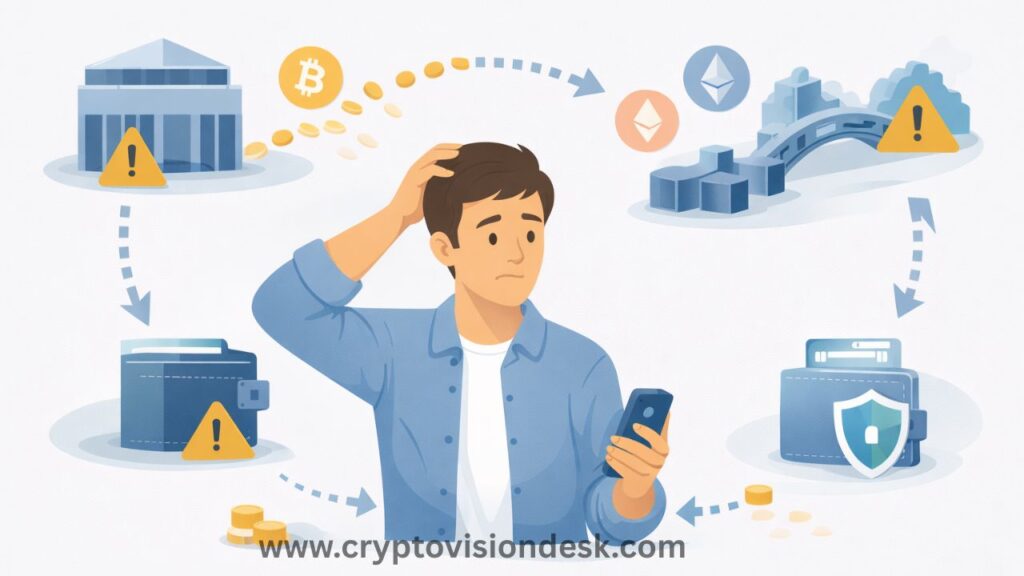
A lot of beginners in 2026 start with an app that feels simple, then end up trading across chains, swapping in wallets, and bridging because a coin is “only on this network.” That’s where platform risk and fee confusion show up.
Three basic categories matter:
- A regulated exchange or broker (often the simplest fiat on-ramp)
- An unregulated exchange or app (higher risk, fewer protections)
- A wallet (you hold the keys, and you’re responsible)
Hidden costs also add up. The big ones are spreads, conversion fees, withdrawal fees, and network fees. On top of that, bridges add a separate risk layer, many major crypto losses have come from bridge exploits and bad bridge UX.
How to choose a safer exchange or broker in your country
You don’t need the “best” exchange on earth. You need a trustworthy one where you live.
A simple selection checklist:
- Licensed or registered where you live (as applicable)
- Clear fee page that matches what you see at checkout
- Strong security history, and transparent incident reporting
- Proof-of-reserves or similar transparency reports (where offered)
- Good withdrawal reputation (people can actually get funds out)
- Responsive support that doesn’t vanish during volatility
One habit that catches problems early: start with a small deposit, then do a test withdrawal. If withdrawals are slow, confusing, or blocked, you learned that with small money, not your whole stack.
Fees that beginners miss, spreads, gas, withdrawal costs, and “free trading” traps
Exchanges love advertising “low fees.” Your real cost is often elsewhere.
Here’s how the common fees show up:
| Cost you pay | What it looks like | Why it matters |
|---|---|---|
| Spread | Buy price is higher than sell price | You lose money before price even moves |
| Conversion fee | “Swap” from USD to USDT, or chain-to-chain conversion | Adds cost without feeling like a trade |
| Withdrawal fee | Flat fee to send coins off-platform | Can be huge for small balances |
| Network (gas) fee | Paid to miners/validators | Spikes during busy periods |
| Bridge fee and slippage | Extra cost when moving cross-chain | Can erase gains and adds risk |
A quick example: you might pay “zero trading fee,” but get hit with a 1.2 percent spread, then a 0.5 percent conversion fee. That’s 1.7 percent before any market move. On a $1,000 buy, that’s $17 gone silently.
Cheaper networks and layer-2s can help, but don’t rush. Always check the network you’re using, the total cost, and whether the token you receive is the one you wanted.
Mistake, leaving your crypto on exchanges or storing it unsafely (seed phrase mistakes)
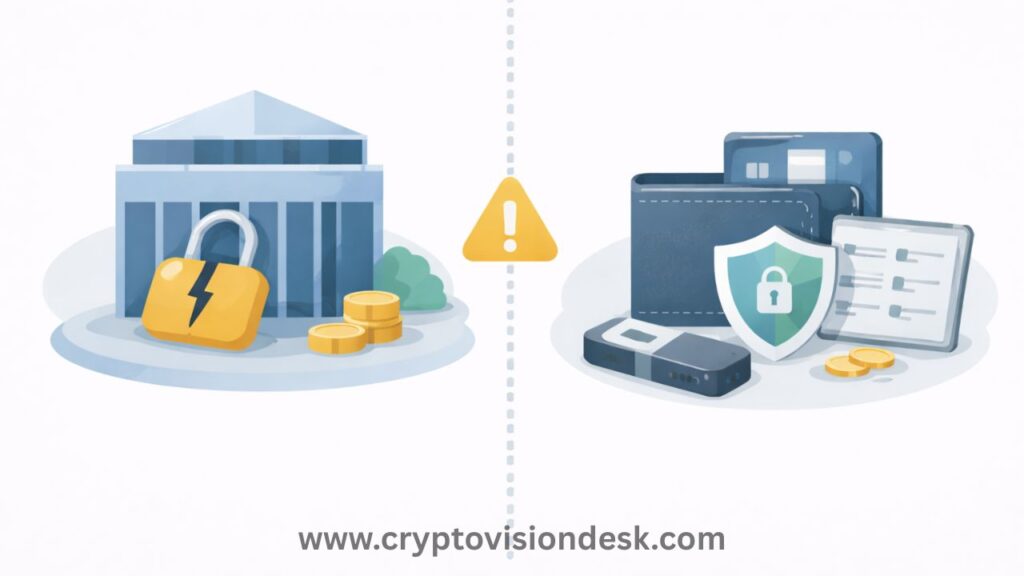
Keeping funds on an exchange is convenient. It’s also a single point of failure. Exchanges can get hacked, freeze withdrawals, lock accounts, or require extra checks at the worst time.
The core rule still holds: not your keys, not your coins.
Beginners don’t need to go all-in on self-custody on day one. A safer middle ground works well:
- Keep a small “trading” amount on the exchange
- Move long-term holdings to a hardware wallet
That simple split reduces both stress and risk. It also forces you to treat long-term holdings like savings, not casino chips.
A beginner safe setup, 2FA, hardware wallet, and a real backup plan
A solid starter setup looks like this:
- Turn on 2FA using an authenticator app (avoid SMS if possible).
- Use a password manager and a unique, long password.
- Buy a hardware wallet for long-term funds, set it up carefully.
- Write your seed phrase on paper or metal, store it offline.
- Keep two backups in two separate safe places.
What never to do:
- Don’t screenshot your seed phrase.
- Don’t store it in cloud notes or email drafts.
- Don’t share it with anyone, not even “support.”
If someone has your seed phrase, they have your money. It’s that simple.
How people lose funds with simple errors, wrong address, wrong network, no test send
Crypto transfers are often final. There’s no “chargeback” button.
The most common beginner mistakes:
- Sending to the right address on the wrong network
- Copying a bad address because of clipboard malware
- Sending the full amount without a test transfer
- Rushing because gas is moving or price is pumping
A good sending habit checklist:
- Verify the first and last characters of the address
- Confirm the network (twice)
- Send a small test amount first
- Only then send the rest
This feels slow the first time. It feels genius the first time it saves you.
Mistake, falling for modern scams (phishing, fake apps, deepfakes, and “support” imposters)
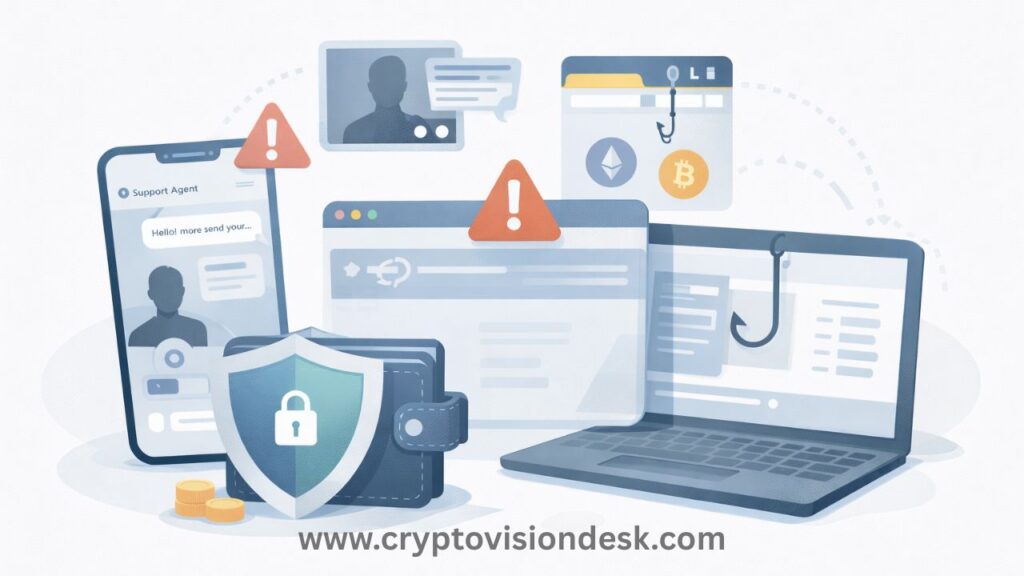
Scams in 2026 are sharper than the old “Nigerian prince” stuff. AI voice and video can mimic real people. Fake sites look nearly perfect. Wallet popups can be forged. DMs can sound like official support.
The rule that cuts through the noise: real support will never ask for your seed phrase, private keys, or for you to “sync your wallet” by entering secrets into a website.
If someone creates urgency, that’s often the scam itself.
The most common crypto scams in 2026 and what they look like
The hits keep repeating:
- Phishing links: Fake login pages for exchanges and wallets.
- Fake wallet extensions: Look like the real thing, steal keys or approvals.
- Airdrop traps: “Free tokens,” then a site asks you to connect and sign.
- Approval scams: You sign a transaction that grants spending rights.
- Impersonation: Friend, influencer, or coworker asks for “quick help.”
- Fake recovery services: “We can recover your funds,” then they drain more.
- Guaranteed return groups: Private chats promising consistent profit.
Two quick examples: A “support agent” DMs you after you tweet a complaint, then asks for your seed phrase to “verify ownership.” A fake airdrop page asks you to sign a transaction, and that signature approves a scam contract to spend your tokens later.
The 60 second safety routine before you click, connect a wallet, or sign a transaction
This takes less than a minute and blocks a lot of losses:
- Use bookmarks for exchanges and wallet sites, don’t trust search ads.
- Check the domain letter-by-letter, not just the logo.
- Don’t connect your main wallet to random sites.
- Read wallet prompts, especially what you’re approving.
- Review token approvals and revoke old ones you don’t use.
- Keep a separate “burner” wallet for experiments and new dapps.
Treat your main wallet like your home address. You don’t hand it out to strangers because they offered free stuff.
Frequently Asked Questions About Crypto Mistakes Beginners Make in 2026
What is the biggest crypto mistake beginners make in 2026?
Buying a coin because it is trending, then reacting emotionally to price swings, is one of the most common mistakes. The fix is simple, write a quick plan before buying, including why you are entering, how long you will hold, where you cut a loss, where you take profit, and how big the position is.
What does a simple crypto buying plan look like for beginners?
A beginner plan can be five lines you fill out before each buy, what you are buying and why, how much you are buying (dollars and percent), where your max loss point is, where you will take some profit, and what new info would change your mind. This prevents panic decisions during dips and pumps.
What should beginners check when they “DYOR” on a token?
Focus on basics that drive risk, use case, total supply and whether it is capped, inflation rate, vesting and unlock schedule, top holder concentration, liquidity depth, and audit status. These checks help you avoid tokens that are set up to dump through unlocks, thin liquidity, or insider control.
What crypto fees do beginners miss most often?
Beginners often miss spreads, conversion fees, withdrawal fees, gas fees, and bridge fees or slippage. “Zero trading fees” can still cost you money through a wide spread and added conversions, so the real cost is what you pay from click to final holdings.
Is it safe to leave crypto on an exchange?
It is convenient but risky because exchanges can get hacked, freeze withdrawals, or lock accounts. A safer middle ground is to keep a small trading amount on the exchange and move long-term holdings to a hardware wallet, with offline seed phrase backups and 2FA enabled.
How much should a beginner invest in crypto?
There is no fixed amount. Beginners should start small, use money they can afford to lose, and increase exposure only after understanding risks, fees, and security basics.
How can beginners spot a crypto scam quickly?
If someone creates urgency, promises guaranteed returns, asks for a seed phrase, or asks you to “sync” your wallet by entering private information, it is almost certainly a scam.
What are the most common crypto scams in 2026?
Common scams include phishing links, fake wallet apps, fake airdrops, approval scams, impersonation of support staff, deepfake influencer videos, and “guaranteed return” private groups.
Conclusion
Most beginner losses in 2026 come from the same five issues:
- FOMO buying without a plan
- Skipping DYOR and ignoring token mechanics
- Trusting the wrong platform, and missing total fees and bridge risk
- Unsafe storage (exchange custody, seed errors)
- Falling for modern scams like phishing and deepfakes
The theme is simple: slow down, do basic checks, secure your keys, and watch the true cost of every move. Pick one upgrade today and do it now, enable 2FA, write a five-line plan, run the DYOR checklist, or move long-term funds to a hardware wallet.
Read Also: Best Crypto Apps For Android, Safe Beginner Picks
Disclaimer
The information provided on this website is published in good faith and for general informational and educational purposes only. It does not constitute financial, investment, trading, legal, or tax advice of any kind.
Cryptocurrencies and digital assets are highly volatile and involve substantial risk. Market conditions can change rapidly, and users may lose some or all of their invested capital. Any actions taken based on the information found on this website are strictly at the reader’s own risk.
References to cryptocurrencies, exchanges, wallets, tools, platforms, or strategies are shared solely for educational awareness and should not be interpreted as recommendations, endorsements, or professional advice.
Readers are advised to conduct their own research (DYOR) and seek guidance from a qualified financial advisor, tax consultant, or legal professional before making any financial or investment decisions.
Cryptocurrency laws, regulations, and taxation policies—particularly in India—may change over time. The content on this website is based on publicly available information at the time of publication and may not reflect the most recent legal or regulatory updates.
The website owner, authors, and contributors do not accept any liability for losses, damages, or consequences arising from the use of the information provided on this website.
Some content on this website may contain affiliate links. This means we may earn a small commission at no additional cost to you. This does not influence the accuracy, transparency, or integrity of the content.