
AI + Crypto Tokens: Are They Worth It In 2026?
AI has gone from science fiction to phone app in just a few years. Since ChatGPT hit the spotlight, every new product pitch seems to include “AI” somewhere in the first line.
Now a new trend sits at the crossroads: AI crypto tokens. These are coins that claim to power AI tools and networks on blockchains. In 2026, they are some of the loudest tickers on crypto Twitter and in Discord chats.
Are they a smart way to get exposure to AI, or just the next hype bubble? This guide breaks down how AI tokens work, looks at real projects like Bittensor (TAO), FET (Artificial Superintelligence Alliance), Render (RENDER), and newer names like DeepSnitch (DSNT), then walks through risks, rewards, and a simple checklist you can use before putting any money on the line.
Nothing here is financial advice. Treat it as education and a starting point for your own research.
What Are AI Crypto Tokens And Why Are They Exploding In 2026?
At a simple level, AI crypto tokens are digital coins that pay for AI work on a blockchain network.
You can think of them like arcade tokens. Instead of inserting a metal coin into a game cabinet, you send an AI token to a smart contract. In return, the network gives you access to:
- AI models
- Data for training
- GPU computing power
Why are people so excited about them in 2026?
They sit at the intersection of three big trends:
- AI models keep getting stronger and more useful.
- Crypto and smart contracts keep spreading.
- Cloud computing costs are rising as AI workloads grow.
In 2025, tokens linked to AI, such as Bittensor, FET, and Render, became some of the most discussed assets on crypto news sites. Big rallies, sharp crashes, and strong stories about “open AI” pulled in both traders and builders.
People like the basic idea because:
- They want open AI, not only products owned by a few Big Tech firms.
- Anyone with data, GPUs, or good AI models can plug into these networks and earn tokens.
- Developers can build apps on top of shared AI rails instead of starting from zero.
The story sounds great on paper, but you need to see how the pieces fit together.
Simple Breakdown: How AI + Crypto Fit Together
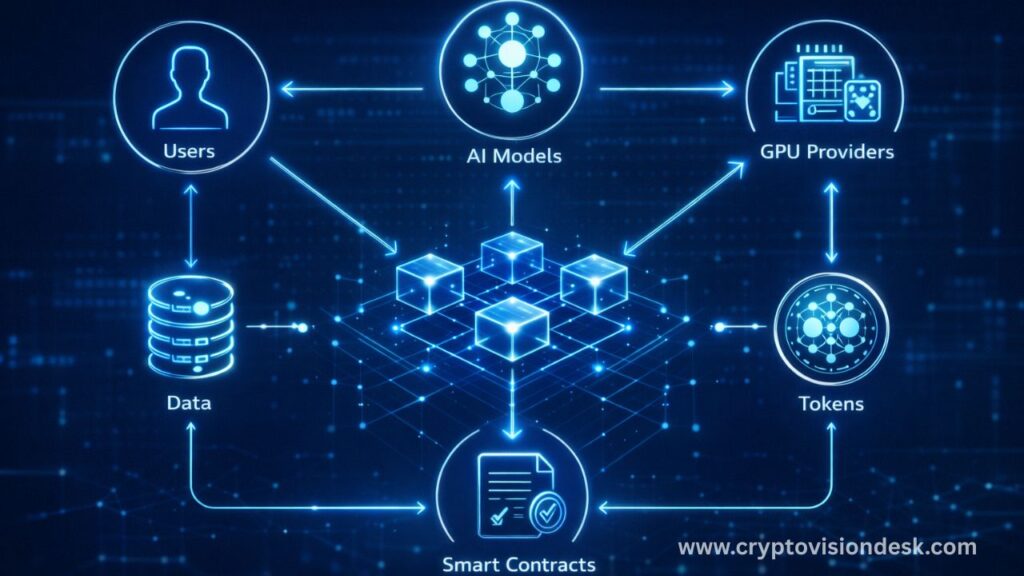
Imagine an AI chatbot that needs three things: data, computing power, and a way to pay everyone who helps.
On an AI crypto network, there are four main roles:
- Providers
People or companies that plug in GPUs or share valuable data. They run software that connects to the network. - Developers
Coders who build apps, such as chatbots, trading bots, or image tools, on top of the network. - Users
Regular people or businesses who want to use those AI tools. They might pay in the network’s token each time they call the model. - The token
The coin that keeps score. Smart contracts pay providers and developers in tokens, and users spend tokens to get AI services.
Smart contracts act like automatic middlemen. They handle:
- Tracking who did what work.
- Sending rewards to the right wallets.
- Charging users each time they use the AI.
No single company has full control. That is the promise. Whether it works in practice is a separate question.
Types Of AI Crypto Projects You See In The Market
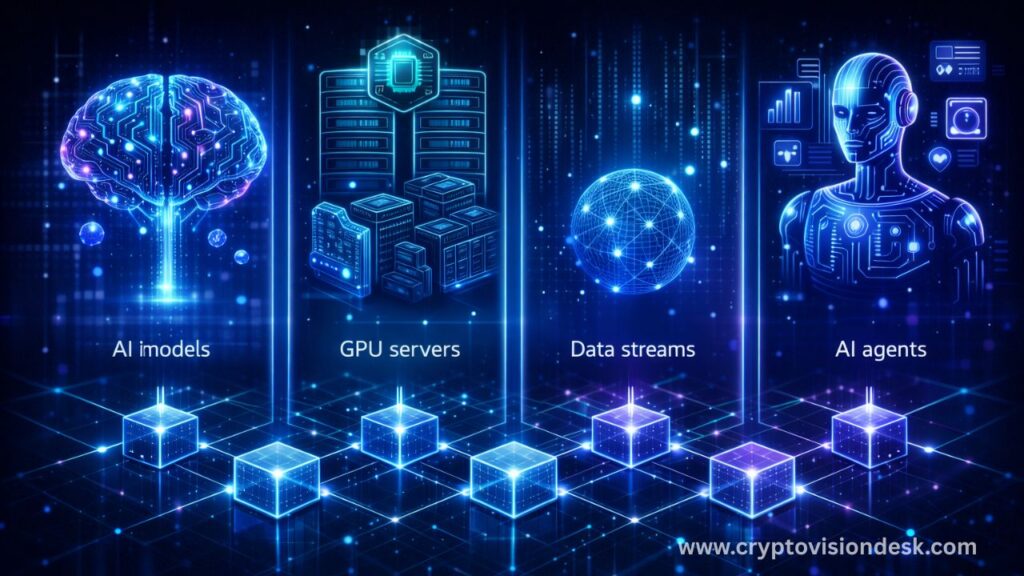
Not every AI token does the same job. Here are the main flavors you see today.
1. AI training and model networks (Bittensor and similar)
These networks invite many AI models to plug in. The best performing models earn more tokens. The goal is a competitive “market” for intelligence where good answers are rewarded.
2. GPU and compute networks (Render and others)
These projects match people who own strong GPUs with those who need power for AI or 3D rendering. Instead of renting from a giant cloud provider, you rent from many small providers through the token network.
3. AI data and indexing networks (Ocean Protocol, The Graph, related tools)
These focus on data. They help list, index, and share information that AI models can train on or query, often in a more open way than closed databases.
4. AI tools and agent platforms (DeepSnitch, trading bots, analytics tools)
These build specific AI tools for crypto: trading agents, fraud detection, wallet assistants, or research bots. Their tokens can pay for access, tip top performers, or secure the network.
Once you see these buckets, news about “the next big AI coin” starts to sound more concrete.
Big Name AI Crypto Tokens In 2026: What Do They Actually Do?

The 2025 market gave AI tokens a mixed record. Some saw big rallies, then deep pullbacks. Sentiment in late 2025 turned cautious, with traders waiting for real usage instead of just stories.
Here is what a few of the better known names actually do in 2026. None of these are buy or sell calls; they are just examples worth studying.
| Token / Project | Main role | Key upside idea | Main risk |
|---|---|---|---|
| Bittensor (TAO) | Network of competing AI models | Open market for AI research | Complex, volatile, still early |
| FET (Artificial Superintelligence) | Network of AI agents and tools | Long term bet on open AGI-style systems | Strong competition, long time line |
| Render (RENDER) | Decentralized GPU and 3D rendering market | Growing need for cheap GPU power | Competing GPU markets, demand risk |
| Ocean, ICP, The Graph, others | Data, hosting, and indexing infrastructure | Core rails for AI and web3 apps | Tech and adoption risk |
| DeepSnitch (DSNT) and presale names | New AI agents, analytics, and trading tools | High upside if product sticks | Extreme risk, unproven products |
Bittensor (TAO): A Decentralized Network For Competing AI Models
Bittensor is a network where many AI models plug in, answer prompts, and get scored by the system. The models that give better answers earn more TAO tokens.
In 2025, TAO was one of the most talked about AI tokens. It saw strong rallies early in the year, then a large drawdown as the market cooled. In December 2025, the network went through its first halving, which cut daily token issuance roughly in half and sparked sharp price swings.
Why people care:
- Upside: Open AI research, rewards for model builders, and a chance for smaller teams to compete with giants.
- Risk: The system is complex, hard to value, and still early. TAO’s price has shown big moves up and down, and future success depends on real usage, not just narrative.
If you study one AI token as a case study, TAO is a solid starting point.
FET And The Artificial Superintelligence Alliance: Betting On Open AGI
FET, tied to the Artificial Superintelligence Alliance, wants to build a network of AI agents that can talk to each other and act on your behalf.
Think of small workers that can:
- Watch markets.
- Move funds between apps with rules you set.
- Connect different data sources and tools.
Supporters see it as a long term play on powerful open AI systems that are not locked inside one company. Through 2025, it stayed grouped with other AI infrastructure tokens, with interest rising on product news and partnerships, then fading when the market turned risk off.
Key points:
- Upside: Exposure to an ambitious “open agents” vision, links to many AI use cases across finance and web3.
- Risk: Heavy pressure from Big Tech AI, long time line for strong agent systems, and price swings tied to general sentiment.
FET is interesting if you think AI agents will be as common as phone apps, but the road there is not short.
Render (RENDER): Turning Extra GPUs Into AI And 3D Power
Render tackles a very clear problem. AI models and 3D graphics both need huge GPU power. Most people cannot afford rows of high-end chips.
Render lets people who own strong GPUs rent them out to those who need power. The token pays GPU providers for completed jobs, while users pay with tokens to get their work done.
Key ideas:
- As AI models grow, demand for GPU hours rises.
- A global, token-based market might offer cheaper or more flexible power than traditional cloud deals.
In 2025, Render often saw interest rise when demand for GPU rendering picked up or when new integrations were announced. At the same time, its price still followed broader market cycles.
Main risk: GPU markets are competitive, and Render must keep demand high from AI apps, artists, and studios. If usage stalls, the token story weakens.
Data And Infra Projects Like Ocean, ICP, And Others
Some of the most useful pieces for AI live in the background.
Projects such as Ocean Protocol, Internet Computer (ICP), and The Graph work on data, hosting, and indexing. They help:
- Store data that AI can tap.
- Host apps that call AI models on-chain.
- Index blockchain data so AI tools can read it.
In 2025, these projects kept building: better tools for developers, more data feeds, and more integrations. Their tokens did not always pump as hard as the “hot narrative” names, but they form an important base layer for AI plus crypto.
New And Hype Driven AI Tokens: DeepSnitch (DSNT) And Presales
Newer AI tokens roll out almost every week. Many start with a presale, a whitepaper, and bold claims.
DeepSnitch (DSNT) is an example of an AI analytics and agent project that has used this path. Reports say it raised funds, ran audits, and built strong marketing around its launch. Similar presales in 2025 sometimes saw large short term gains when trading began.
You need to treat these with extreme care:
- Presales can offer huge upside if the team ships a good product and demand shows up.
- They also carry even bigger risk because the code, the team, and the market fit are new and unproven.
Never rely only on marketing claims or influencer threads. If you choose to play with presales, size them as very small, high-risk bets.
Are AI Crypto Tokens A Good Investment In 2026 Or Just Hype?
The honest answer: it depends on your risk level, time horizon, and how much work you put into research.
In late 2025, market sentiment around AI tokens turned cautious or bearish. Prices for many names moved sideways or down after earlier rallies, even while long term forecasts stayed upbeat. That mix will likely carry into 2026.
Let’s look at the case for and against them.
Real Benefits: Why People Are Bullish On AI Tokens
Here is what draws investors in:
- Two hot trends at once
AI tokens give exposure to both AI and crypto. If either grows, the story stays interesting. - Support for open AI
Some buyers like that they are backing systems that are not fully owned by Big Tech. - Rewards for sharing resources
People can earn tokens by renting out GPUs, data, or AI models, instead of selling those services through a single company. - Fuel for new apps
AI tokens can power tools in gaming, finance, and real world asset platforms. For example, an AI trading agent on FET-style rails, or a game that calls models hosted on an AI compute network.
If adoption keeps rising, tokens that sit at the center of real usage have a stronger case.
Serious Risks: Volatility, Hype Cycles, And Tech That May Fail
Now the hard part.
- Huge price swings
AI coins can jump 30 percent in a week and fall just as fast. This is not a fit for anyone who needs short term stability. - Ideas instead of products
Many tokens trade on whitepapers and roadmaps, not live apps. Some teams never ship. - Narrative pumps
A good story can send a coin up when attention hits, then back down once the crowd moves to the next thing. - Bear market pain
Even strong names like TAO, FET, or RENDER saw heavy drops during risk-off periods in 2025.
On top of that, AI tech itself changes fast. A project that looks clever today can feel old in two years if it does not keep pace.
What 2025 Taught Us About AI Tokens Going Into 2026
From the 2025 cycle, a few lessons stand out:
- Tokens tied to clear use cases (GPU markets, data networks, indexing, AI agent platforms) held attention longer.
- Presales with strong marketing produced big early winners but also many disappointments when products lagged.
- “AI rails” and layer 1 chains that host AI apps performed relatively better than random micro-caps with no clear role.
2026 may repeat some of these patterns, but past gains do not promise future returns. Treat every chart with caution.
Red Flags To Watch For With Any New AI Crypto Project
Here is a quick checklist of warning signs:
- Whitepaper full of buzzwords, light on details.
- No working demo, testnet, or code you can inspect.
- Anonymous team with no track record or verifiable history.
- Tokenomics that send a large slice to insiders and unlock fast.
- Promises of “guaranteed” returns or fixed daily yields.
- No third-party audits or vague comments about security.
- Aggressive marketing that leads with AI hype, not real problems solved.
If you see several of these at once, walk away or treat the coin as a pure gamble, not an investment.
Read Also: How To Earn Money With Crypto in 2026: 7 Safe Ways
How To Decide If AI Crypto Tokens Are Worth It For You In 2026

AI tokens are not “must own” assets. They are high-risk, high-uncertainty plays that can fit a portfolio only after you know yourself and your plan.
Start With Your Risk Level And Time Horizon
Ask yourself:
- Can I watch my holdings drop 50 to 80 percent without panic selling?
- Am I ready to hold for years, not weeks, if the story takes time to play out?
- Can I afford to lose every dollar I put into these coins?
For most people, AI tokens, if used at all, should sit in a small, speculative slice of their portfolio, not the core. Think “fun money” or advanced tech exposure, not retirement base.
Research Framework: 7 Questions To Ask Before You Buy
Before you press “buy,” answer these seven questions in writing:
- What real problem does this project solve?
- Who uses it today, and how often?
- Does the token have a real role, or is it just for speculation?
- Who is on the team, and what have they built before?
- Is the code open source or audited by a known firm?
- How are tokens split between team, investors, and community?
- How does this project compare with larger players like TAO, FET, or RENDER?
If you cannot answer these in plain language, slow down.
Smarter Ways To Get AI Exposure Without Going All In On Tiny Coins
You do not have to bet everything on the newest micro-cap.
Some ideas:
- Spread risk across a few leading AI tokens instead of one small name.
- Hold major chains that host AI apps, such as popular layer 1 networks used by AI teams, as indirect exposure.
- Use dollar-cost averaging into any position instead of one big buy.
- Spend more time learning and tracking the space than trading every headline.
Patience, position sizing, and risk control usually beat chasing every fresh presale on social media.
Conclusion
AI plus crypto is a powerful idea, and projects like Bittensor, FET, Render, and core data networks already show real use cases, not just stories. At the same time, the sector in 2026 is still young, crowded, and very risky.
AI tokens can make sense for tech-aware investors who accept big volatility, do deep research, and treat them as a small, speculative slice of a broader plan. They rarely fit people who need stability, short time lines, or who do not have time to study the space.
If you decide to explore this corner of the market, start small, stay curious, and think in years instead of days. Nothing here is financial advice; your best edge is careful research, clear rules, and a calm mind when the next wave of hype hits.
Read Also: What Is Cryptocurrency? Your Simple Beginner Guide to Bitcoin & Crypto
Disclaimer
The information provided on this website is published in good faith and for general informational and educational purposes only. It does not constitute financial, investment, trading, legal, or tax advice of any kind.
Cryptocurrencies and digital assets are highly volatile and involve substantial risk. Market conditions can change rapidly, and users may lose some or all of their invested capital. Any actions taken based on the information found on this website are strictly at the reader’s own risk.
References to cryptocurrencies, exchanges, wallets, tools, platforms, or strategies are shared solely for educational awareness and should not be interpreted as recommendations, endorsements, or professional advice.
Readers are advised to conduct their own research (DYOR) and seek guidance from a qualified financial advisor, tax consultant, or legal professional before making any financial or investment decisions.
Cryptocurrency laws, regulations, and taxation policies—particularly in India—may change over time. The content on this website is based on publicly available information at the time of publication and may not reflect the most recent legal or regulatory updates.
The website owner, authors, and contributors do not accept any liability for losses, damages, or consequences arising from the use of the information provided on this website.
Some content on this website may contain affiliate links. This means we may earn a small commission at no additional cost to you. This does not influence the accuracy, transparency, or integrity of the content.